

The BMW M12/10 is a 1,499 cc, inline — four turbocharged Formula 1 racing engine developed for the FIA Formula One World Championship. Derived from the production M10 block, it features a single overhead camshaft (SOHC), 8 — valve configuration, and Kugelfischer mechanical fuel injection. In race trim, it produced over 1,400 PS in qualifying "boost mode" with power outputs varying significantly based on boost pressure and fuel mixture.
Used by the Brabham team (BT52, BT5…
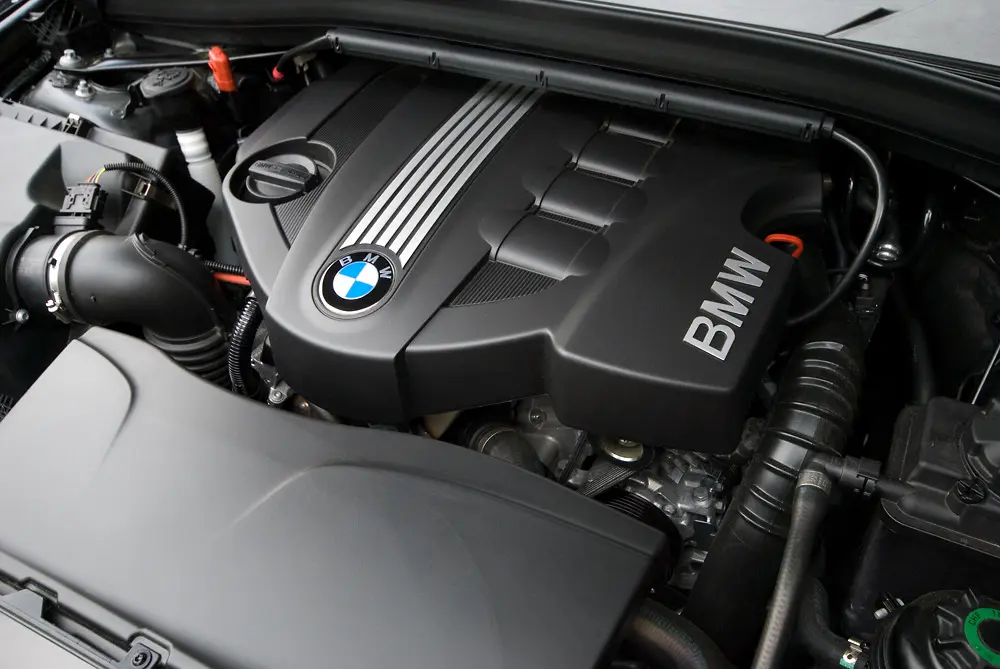
Production race engines 1982–1987 met FIA Formula One regulations (FIA Homologation #FIA/F1/82-001).
The BMW M12/10 is a 1,499 cc inline-four turbocharged Formula 1 engine engineered for the highest level of motorsport competition (1982–1987). It combines a modified M10 block with a single Garrett T03 turbocharger and mechanical fuel injection to deliver extreme power output. Designed to meet FIA Formula One regulations, it represents the pinnacle of BMW's motorsport engineering during the turbocharged era.
| Parameter | Value | Source |
|---|---|---|
Displacement | 1,499 cc | |
Fuel type | Racing gasoline (102–108 RON, leaded) | |
Configuration | Inline-4, SOHC, 8-valve | |
Aspiration | Turbocharged (single turbo, anti-lag system) | |
Bore × stroke | 89.0 mm × 60.0 mm | |
Power output | 850–1,400 PS (race/qualifying boost) | |
Torque | 500–650 Nm (depending on boost) | |
Fuel system | Kugelfischer mechanical fuel injection | |
Emissions standard | Not applicable (racing engine) | |
Compression ratio | 7.5:1 | |
Cooling system | Water-cooled (race-spec radiator) | |
Turbocharger | Garrett T03 (variable boost, anti-lag) | |
Timing system | Chain (reinforced, dry sump system) | |
Oil type | Shell Race Oil 10W-50 (dry sump system) | |
Dry weight | 135 kg |
The BMW M12/10 was used exclusively in Formula 1 race cars with mid-engine mounting. This engine received team-specific adaptations—different turbo manifolds in the Brabham BT52 and revised cooling in the Arrows A10—and from 1986 the Benetton B186 variant with enhanced engine management, creating interchange limits. All adaptations are documented in team and BMW Motorsport technical bulletins.
The M12/10's primary reliability challenges were inherent to its design as an extreme-performance race engine. Thermal stress, turbocharger failure, and internal component fatigue were common, especially in qualifying mode. These were accepted trade-offs for achieving record-breaking power output. Engines were designed for short lifespan and regular rebuilds, not long-term durability.
Analysis derived from BMW Motorsport documentation (1982–1987), FIA regulations, and contemporary motorsport reporting. This engine was not subject to consumer reliability metrics.
The most common questions about engine codes, what they mean, how to find them and how this database works
The M12/10 was not designed for long-term reliability. It was a race engine built for maximum performance over a single race weekend. Reliability was a secondary concern to power output. Engines were routinely rebuilt after every event due to the extreme stresses involved. In this context, 'reliability' meant finishing a race, not longevity.
The most common issues were turbocharger failure due to extreme boost, cylinder head warping from thermal stress, internal component fatigue (pistons, rods), and fuel system instability. These were inherent challenges of the turbocharged Formula 1 formula and were managed through constant development and engine rebuilds rather than being 'fixed'.
The M12/10 was never used in any production BMW road car. It was a Formula 1 racing engine used exclusively by customer teams: Brabham (1982–1985), Arrows (1984–1987), and Benetton (1986–1987). It powered Nelson Piquet to the 1983 World Drivers' Championship.
Yes, the M12/10 was highly tunable, primarily through boost pressure and fuel mixture adjustments. In 1986 qualifying trim, it produced over 1,400 PS. However, gains came at the cost of reliability, with engines often lasting only a few laps at maximum boost. Tuning was performed by specialized race engineers using period-correct equipment.
Fuel economy is not a relevant metric for a Formula 1 engine. The M12/10 consumed fuel at an extremely high rate, especially in qualifying mode. Fuel strategy was critical in races, with teams balancing performance against the need to carry sufficient fuel. Consumption could exceed 100 L/100km under full power.
Yes, like most high-performance engines of its era, the M12/10 is an interference engine. If the timing chain fails, piston-to-valve contact will occur, resulting in catastrophic internal damage. Given the engine's high RPM and power, such a failure would be immediate and destructive.
The M12/10 uses a dry sump lubrication system requiring specialized racing oil. BMW Motorsport specified Shell Race Oil 10W-50 or equivalent high-zinc, high-detergent racing formulation. Oil was changed after every race session as part of the routine rebuild process.
Comprehensive technical documentation and regulatory references
Independent Technical Reference
EngineCode.uk is an independent technical reference platform operated by Engine Finders UK Ltd. We are not affiliated with BMW or any other manufacturer. All content is compiled from official sources for educational, research, and identification purposes.
Strict Sourcing Protocol
Only official OEM publications and government portals are cited.
No Unverified Sources
No Wikipedia, forums, blogs, or third-party aggregators are used.
Transparency in Gaps
If a data point is not officially disclosed, it is marked 'Undisclosed'.
Regulatory Stability
EU regulations are referenced using CELEX identifiers for long-term stability.
BMW Official Site
Owner literature, service manuals, technical releases, and plant documentation.
EUR-Lex
EU emissions and type-approval regulations (e.g., CELEX:32007R0715, CELEX:32017R1151).
GOV.UK: Vehicle Approval & V5C
UK vehicle approval processes, import rules, and MoT guidance.
DVLA: Engine Changes & MoT
Official guidance on engine swaps and inspection implications.
Vehicle Certification Agency (VCA)
UK type-approval authority for automotive products.
Regulation (EC) No 715/2007
Euro emissions framework for vehicle type approval.
Commission Regulation (EU) 2017/1151
WLTP and RDE testing procedures for emissions certification.
GOV.UK: Vehicle Approval
UK compliance and certification requirements for imported and modified vehicles.
VCA Certification Portal
Type-approval guidance and documentation.
Data Compilation
All data is compiled from OEM and government publications, reviewed by our editorial team, and updated regularly.
Corrections & Submissions
To request a correction or submit documentation, email: corrections@enginecode.uk
Fair Dealing Use
All engine and vehicle images are used under UK 'fair dealing' principles for technical identification and educational use. Rights remain with their respective owners.
Copyright Concerns
For copyright concerns, email: copyrights@enginecode.uk
GDPR Compliance
EngineCode.uk complies with UK GDPR. We do not collect personal data unless explicitly provided.
Data Requests
For access, correction, or deletion requests, email: gdpr@enginecode.uk
Trademark Notice
All trademarks, logos, and engine codes are the property of their respective owners. Use on this site is strictly for reference and identification.
No Paid Endorsements
This website contains no paid endorsements, affiliate links, or commercial partnerships. We do not sell parts or services.
Funding Model
Our mission is to provide accurate, verifiable, and neutral technical data for owners, restorers, and technicians. This site is self-funded.
All specifications and compatibility data verified against officialBMW documentation and EU/UK regulatory texts. Where official data is unavailable, entries are marked “Undisclosed”.
All external links open in new tabs. Please verify current availability of resources.