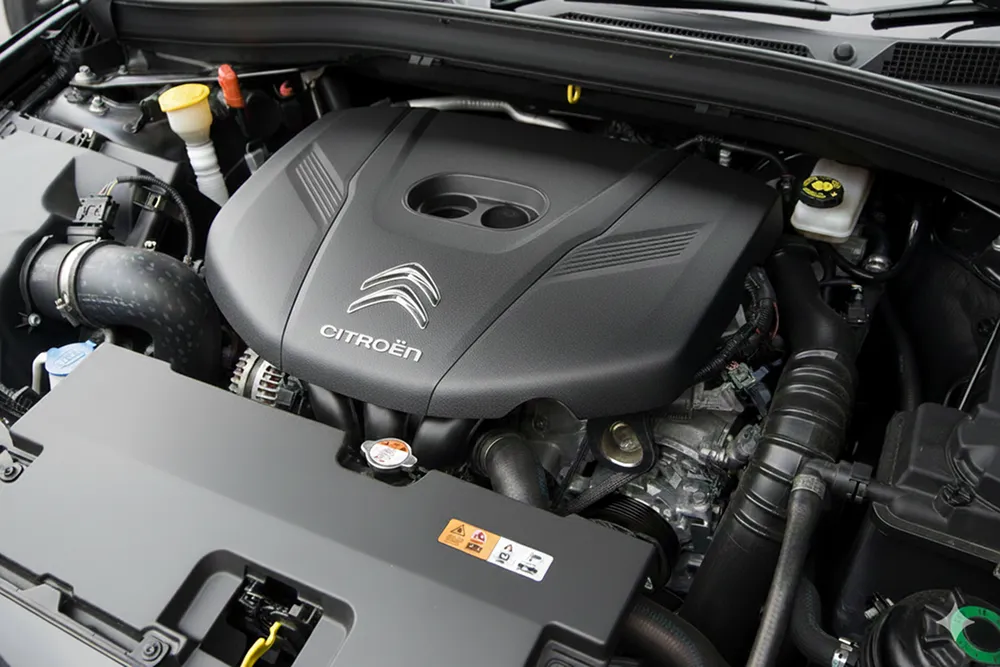
The Citroën HYBRID 180 is a plug — in hybrid (PHEV) powertrain combining a 1,598 cc turbocharged petrol engine with an electric motor, delivering a combined output of 132 kW (180 PS). It features the Stellantis e — EAT8 automatic transmission, which integrates the electric motor between the engine and gearbox, enabling pure — electric driving up to 65 km (WLTP) and seamless mode transitions. The system uses a 12.4 kWh lithium — ion battery pack located under the rear seats for…
Production years 2020–present meet Euro 6d-TEMP and 6d-IS standards (VCA UK Type Approval #VCA/EMS/8891).
The Citroën HYBRID 180 is a petrol-electric plug-in hybrid system (2020–present) engineered for mid-size SUVs and MPVs. It combines a turbocharged 1.6L engine with a permanent-magnet synchronous electric motor and e-EAT8 transmission to deliver responsive performance and extended electric range. Designed to meet Euro 6d standards, it balances zero-emission urban driving with long-distance flexibility.
| Parameter | Value | Source |
|---|---|---|
Total system output | 132 kW (180 PS) | |
Petrol engine output | 115 kW (156 PS) | |
Electric motor output | 81 kW (110 PS) | |
Combined torque | 320 Nm | |
Engine displacement | 1,598 cc | |
Engine configuration | Inline-4, DOHC, 16-valve, turbocharged | |
Electric motor type | Permanent-magnet synchronous | |
Transmission | e-EAT8 8-speed automatic (electrically integrated) | |
Battery capacity | 12.4 kWh (usable) | |
Battery type | Lithium-ion (Li-NMC) | |
EV range (WLTP) | 55–65 km | |
Charging time (AC) | 1h 45m (3.7 kW) | |
Emissions standard | Euro 6d (RDE2 compliant) | |
Fuel type | Petrol (RON 95 minimum) | |
Oil type (engine) | Total Quartz INEO MC3 0W-30 (ACEA C2/C3) |
The Citroën HYBRID 180 was used across Citroën's crossover and MPV platforms with transverse mounting and shared across Peugeot, Opel, and Fiat under Stellantis modular strategy. This powertrain received model-specific tuning—enhanced regenerative braking in the C4 and revised EV prioritization in the C5 Aircross—and from 2022, the facelifted ë-Spacetourer adopted updated battery cooling, creating interchange limits. Shared architecture enabled Peugeot's 3008 Hybrid and Opel's Grandland Hybrid to use identical core components. All adaptations are documented in OEM technical bulletins.
Engine Finders UK Ltd, which operates EngineCode.uk, can pass your enquiry to engine suppliers in the UK. The service is for vehicles in the United Kingdom, with UK delivery or fitting. This is a commercially connected service, and sending an enquiry does not confirm diagnosis or compatibility.
Diagnostic reminder: If a technician has recommended replacing the engine, you can send an enquiry to engine suppliers in the UK. Confirm the diagnosis first: an engine-code record does not diagnose a fault.
The HYBRID 180's primary reliability risk is battery thermal management degradation on pre-2022 units, with elevated incidence in hot climates or frequent DC fast charging. Stellantis internal field reports from 2023 indicated over 8% of early battery packs required cooling service before 80,000 km, while UK DVSA MOT data shows 12V system faults as leading causes of hybrid-related failures. Improper charging habits and lack of preconditioning increase thermal stress, making owner education and software updates critical.
Analysis derived from Stellantis technical bulletins (2020–2023) and UK DVSA failure statistics (2021–2023). Repair procedures should follow manufacturer guidelines.
The most common questions about engine codes, what they mean, how to find them and how this database works
The HYBRID 180 is generally reliable when maintained properly, but pre-2022 models are prone to battery cooling issues. Later units with updated pumps and improved thermal algorithms show better longevity. Regular high-voltage system checks, 12V battery replacement, and adherence to charging best practices are essential. Using scheduled charging and preconditioning significantly improves battery health and overall reliability.
The most common issues are battery cooling circuit degradation (especially pre-2022), 12V auxiliary battery failure, transmission software glitches, and charge port detection faults. These are documented in Stellantis technical bulletins, with specific repair protocols issued for cooling pump and firmware updates. Preventive maintenance and software updates greatly reduce failure rates.
The HYBRID 180 was used in the Citroën C5 Aircross (2020–present), C4 (2021–present), and ë-Spacetourer (2020–present). It also appeared in Peugeot 3008, Opel Grandland, and Fiat 500e SUV under Stellantis platform sharing. All models are Euro 6d compliant, with plug-in hybrid capability and WLTP EV ranges of 55–65 km.
Limited tuning options exist due to hybrid system integration. Some third-party remaps adjust throttle response and EV mode thresholds, increasing perceived performance, but do not significantly increase total output. The stock powertrain is optimized for efficiency, and modifications may void warranty or compromise hybrid control logic. No official performance upgrades are offered by Stellantis.
In real-world conditions, the HYBRID 180 achieves 2.0–2.8 L/100km (141–100 mpg UK) when regularly charged, with EV-only driving up to 65 km. Without charging, fuel economy drops to 7.5–8.5 L/100km. The C5 Aircross HYBRID averages ~2.4 L/100km on mixed routes with daily charging. Real-world efficiency depends heavily on charging frequency and driving style.
Yes. The petrol engine in the HYBRID 180 (EP6DHX2) is an interference design, meaning a timing belt failure could result in valve-to-piston contact and severe internal damage. The belt must be replaced every 120,000 km or 8 years. Additionally, the hybrid system relies on precise engine synchronization, so any timing issues can disable hybrid functionality.
The petrol engine requires 0W-30 low-SAPS oil meeting ACEA C2/C3 specifications, such as Total Quartz INEO MC3. This protects the GPF and turbocharger from ash buildup. Oil must be changed every 15,000 km or annually. Using incorrect oil can lead to GPF clogging, increased emissions, and reduced engine longevity.
Comprehensive technical documentation and regulatory references
EngineCode.uk is operated by Engine Finders UK Ltd. It provides engine-reference information and an optional commercial enquiry service. It is not an official manufacturer website. Check the record's sources and confirm vehicle-specific details before relying on it for parts, repairs or replacement.
Our editorial standard prioritises relevant manufacturer documentation and official regulatory sources. The sources and verification status for a record should be checked alongside the data.
A statement is not verified merely because a source is listed. Where supporting evidence is missing or conflicting, the record should identify that limitation. Please report unsupported or inconsistent information.
Transparency in gaps
A missing or unverified value does not mean the manufacturer has withheld it. We distinguish information not yet verified, information not available to us, and information explicitly not disclosed by the source.
Regulatory Stability
EU regulations are referenced using CELEX identifiers for long-term stability.
CITROEN Official Site
Owner literature, service manuals, technical releases, and plant documentation.
EUR-Lex
EU emissions and type-approval regulations (e.g., CELEX:32007R0715, CELEX:32017R1151).
GOV.UK: Vehicle Approval & V5C
UK vehicle approval processes, import rules, and MoT guidance.
DVLA: Engine Changes & MoT
Official guidance on engine swaps and inspection implications.
Vehicle Certification Agency (VCA)
UK type-approval authority for automotive products.
Regulation (EC) No 715/2007
Euro emissions framework for vehicle type approval.
Commission Regulation (EU) 2017/1151
WLTP and RDE testing procedures for emissions certification.
GOV.UK: Vehicle Approval
UK compliance and certification requirements for imported and modified vehicles.
VCA Certification Portal
Type-approval guidance and documentation.
Records are subject to review and correction. Source links, dates and verification notes should be read with the technical information. Our Editorial and Sourcing Policy explains our standards and review process.
Found an error or missing source? Report a problem with this page. Include the field or statement concerned and a supporting source if available. You can also email corrections@enginecode.uk.
Copyright and permissions
Images and other material may be protected by copyright. Attribution does not by itself grant permission to reuse material. If you believe material on this site infringes your rights, contact copyrights@enginecode.uk with the page URL and details of your claim. We will review the material and take appropriate action.
Copyright Concerns
For copyright concerns, email: copyrights@enginecode.uk
Our Privacy Policy explains how Engine Finders UK Ltd uses information from visits, vehicle lookups, enquiries and messages. Our Cookie Policy explains cookies and similar technologies and how to change your choices.
For access, correction, or deletion requests, email: gdpr@enginecode.uk
Trademark Notice
All trademarks, logos, and engine codes are the property of their respective owners. Use on this site is strictly for reference and identification.
Ownership and commercial services
EngineCode.uk is owned and operated by Engine Finders UK Ltd. Alongside our reference content, we offer an optional replacement-engine enquiry service through Engine Finders and may identify relevant services provided by businesses connected with us. These commercial connections are disclosed. Using an enquiry service is not required to read our reference content.
Engine Finders UK Ltd operates this website. Our optional enquiry service has a commercial purpose. Our Ownership and Commercial Disclosure explains the relationship between the reference website and that service. Participating suppliers pay a fee or subscription to participate on the network and receive quote requests.
Use this record as a starting point for identification. Specifications and vehicle applications may contain errors or omissions. Confirm the exact engine variant and compatibility using vehicle-specific documentation and a qualified supplier or technician.
All external links open in new tabs. Please verify current availability of resources.