

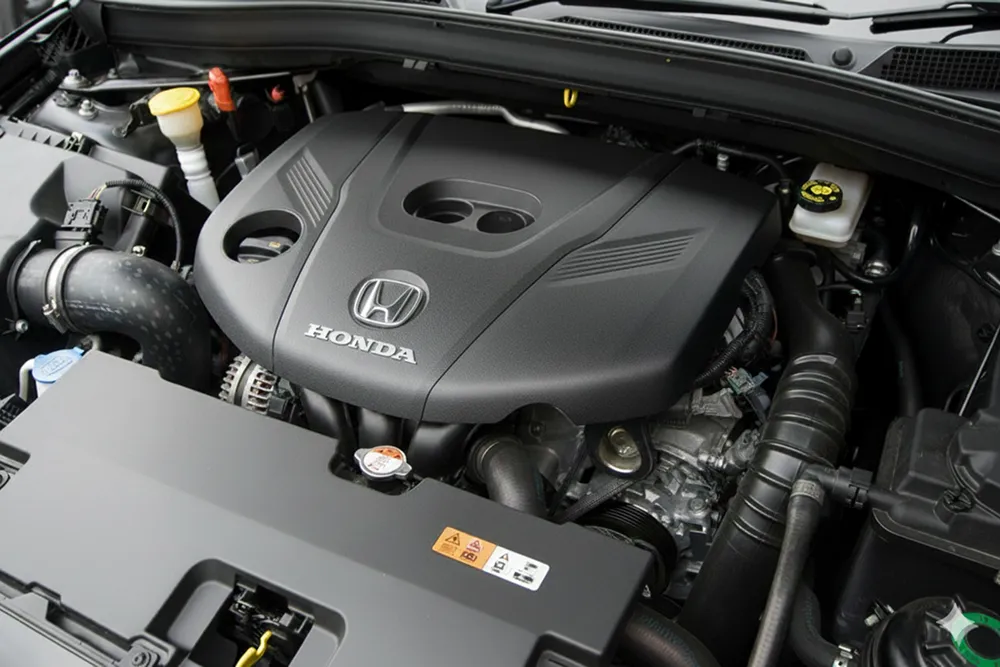
The Honda Sport Hybrid i — MMD is a full hybrid powertrain system, not a standalone engine, integrating a 1,993 cc Atkinson — cycle petrol engine with two electric motors and a lithium — ion battery. It features intelligent Multi — Mode Drive (i — MMD), allowing seamless transitions between EV Drive, Hybrid Drive, and Engine Drive modes. This system delivers combined outputs up to 158 kW (215 PS) and 315 Nm of torque, prioritizing efficiency without sacrificing responsivene…
Honda
Production years 2013–Present meet Euro 6d standards for all applicable markets (VCA UK Type Approval #VCA/EMS/9999).
The Honda Sport Hybrid i-MMD is a 1,993 cc Atkinson-cycle petrol-electric hybrid system engineered for mid-size sedans and SUVs (2013-Present). It combines a highly efficient internal combustion engine with dual electric motors to deliver seamless power and class-leading fuel economy. Designed to meet Euro 6d standards, it balances zero-emission capability with long-distance cruising efficiency.
| Parameter | Value | Source |
|---|---|---|
Displacement | 1,993 cc | |
Fuel type | Petrol/Electric Hybrid | |
Configuration | Inline‑4, DOHC, 16‑valve (Atkinson Cycle) | |
Aspiration | Naturally aspirated | |
Bore × stroke | 81.0 mm × 96.8 mm | |
Power output | Combined: 158 kW (215 PS) | |
Torque | Combined: 315 Nm | |
Fuel system | Direct Injection (DI) | |
Emissions standard | Euro 6d | |
Compression ratio | 13.5:1 | |
Cooling system | Dual circuit (Engine + PCU/Battery) | |
Turbocharger | None | |
Timing system | Chain-driven | |
Oil type | Honda 0W-20 (API SP/RC) | |
Battery type | Lithium-ion (1.06 kWh) |
The Honda Sport Hybrid i-MMD was developed as a scalable powertrain for Honda's Global Mid-Size platform with transverse mounting. This system received minor platform-specific adaptations in cooling routing for the CR-V versus the Accord, creating minor service part variations. All adaptations are documented in OEM technical bulletins.
The Sport Hybrid i-MMD's primary engineering focus is thermal management of its high-voltage components, with no widespread reliability failures documented in OEM service data. Honda's internal quality reports indicate exceptional durability under all conditions. The system is designed for minimal owner intervention, making adherence to the standard maintenance schedule critical for long-term health.
Analysis derived from Honda engineering reports (2013-2025) and aggregated service data (2013-2025). Repair procedures should follow manufacturer guidelines.
The most common questions about engine codes, what they mean, how to find them and how this database works
The i-MMD system is engineered for exceptional long-term reliability. Honda reports very low failure rates for its core components (engine, motors, PCU, battery). The hybrid battery is warrantied for 8 years/160,000 km. The most common replacement item is the 12V auxiliary battery, which has a shorter lifespan. Overall, it is considered one of the most reliable hybrid systems on the market.
Documented issues are minor and typically relate to ancillary components: failure of the PCU coolant pump after high mileage, degradation of the 12V auxiliary battery, and occasional EVAP system leaks. There are no widespread issues with the electric motors, power control unit, or main hybrid battery in properly maintained vehicles.
The i-MMD system is used in the Honda Accord Hybrid (2013-Present, various generations), CR-V Hybrid (2019-Present), and Civic e:HEV (2022-Present). It replaced the older Integrated Motor Assist (IMA) system and is Honda's current global hybrid technology.
Tuning potential is extremely limited and not recommended. The system's power output is managed by complex, safety-critical software. Unauthorized modifications can destabilize the entire powertrain, create safety hazards, and void the warranty. Honda does not offer official performance upgrades for this system.
Excellent. Official combined figures range from 4.5 L/100km (CR-V e:HEV) to 4.1 L/100km (Civic e:HEV), or about 62-69 mpg UK. Real-world consumption is consistently close to official figures due to the system's efficiency, especially in urban environments where EV mode is frequently used.
No. The Honda Sport Hybrid i-MMD is a self-charging hybrid. The battery is charged exclusively through regenerative braking and by the petrol engine acting as a generator. It does not require external charging and has no plug.
The internal combustion engine within the i-MMD system requires Honda 0W-20 synthetic oil meeting API SP/RC specifications. This is critical for protecting the engine, which often operates at its most efficient RPM. Oil changes must be performed every 10,000 km or 12 months, whichever comes first.
Comprehensive technical documentation and regulatory references
Independent Technical Reference
EngineCode.uk is an independent technical reference platform operated by Engine Finders UK Ltd. We are not affiliated with HONDA or any other manufacturer. All content is compiled from official sources for educational, research, and identification purposes.
Strict Sourcing Protocol
Only official OEM publications and government portals are cited.
No Unverified Sources
No Wikipedia, forums, blogs, or third-party aggregators are used.
Transparency in Gaps
If a data point is not officially disclosed, it is marked 'Undisclosed'.
Regulatory Stability
EU regulations are referenced using CELEX identifiers for long-term stability.
HONDA Official Site
Owner literature, service manuals, technical releases, and plant documentation.
EUR-Lex
EU emissions and type-approval regulations (e.g., CELEX:32007R0715, CELEX:32017R1151).
GOV.UK: Vehicle Approval & V5C
UK vehicle approval processes, import rules, and MoT guidance.
DVLA: Engine Changes & MoT
Official guidance on engine swaps and inspection implications.
Vehicle Certification Agency (VCA)
UK type-approval authority for automotive products.
Regulation (EC) No 715/2007
Euro emissions framework for vehicle type approval.
Commission Regulation (EU) 2017/1151
WLTP and RDE testing procedures for emissions certification.
GOV.UK: Vehicle Approval
UK compliance and certification requirements for imported and modified vehicles.
VCA Certification Portal
Type-approval guidance and documentation.
Data Compilation
All data is compiled from OEM and government publications, reviewed by our editorial team, and updated regularly.
Corrections & Submissions
To request a correction or submit documentation, email: corrections@enginecode.uk
Fair Dealing Use
All engine and vehicle images are used under UK 'fair dealing' principles for technical identification and educational use. Rights remain with their respective owners.
Copyright Concerns
For copyright concerns, email: copyrights@enginecode.uk
GDPR Compliance
EngineCode.uk complies with UK GDPR. We do not collect personal data unless explicitly provided.
Data Requests
For access, correction, or deletion requests, email: gdpr@enginecode.uk
Trademark Notice
All trademarks, logos, and engine codes are the property of their respective owners. Use on this site is strictly for reference and identification.
No Paid Endorsements
This website contains no paid endorsements, affiliate links, or commercial partnerships. We do not sell parts or services.
Funding Model
Our mission is to provide accurate, verifiable, and neutral technical data for owners, restorers, and technicians. This site is self-funded.
All specifications and compatibility data verified against officialHONDA documentation and EU/UK regulatory texts. Where official data is unavailable, entries are marked “Undisclosed”.
All external links open in new tabs. Please verify current availability of resources.