

The Jaguar 8C is a 3,442 cc, inline — six, dual overhead camshaft (DOHC) petrol engine produced between 1954 and 1957. It was developed as a high — performance evolution of the XK engine series, featuring a straight — port cylinder head and triple SU carburettors in standard tune. This configuration delivered 190 bhp at 5,500 rpm, enabling sports — sedan performance that defined Jaguar's racing pedigree during the mid — 1950s.
Fitted to the iconic XK150 and select XK140 model…
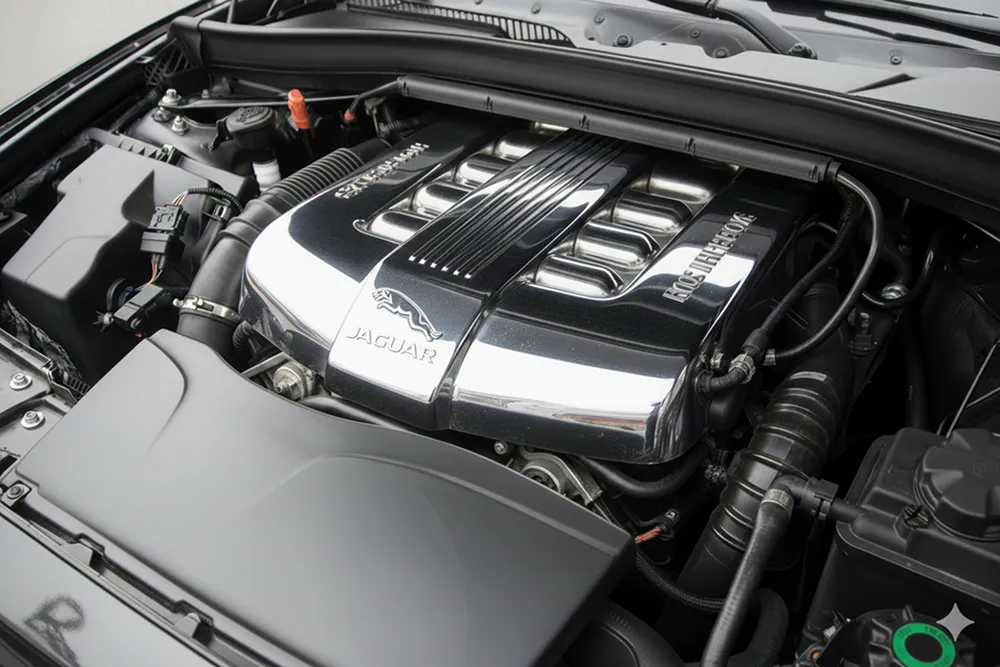
Jaguar
Production years 1954–1957 predate modern emissions standards. Engine specifications comply with contemporary SAE J245 performance measurement protocols (SAE International Doc. J245_195304).
The Jaguar 8C is a 3,442 cc inline-six, DOHC petrol engine engineered for high-performance sports cars (1954–1957). It combines hemispherical combustion chambers with dual overhead camshafts to deliver high-rpm power and smooth operation. Designed before emissions regulations, it prioritises mechanical efficiency and driver engagement.
| Parameter | Value | Source |
|---|---|---|
Displacement | 3,442 cc | |
Fuel type | Petrol | |
Configuration | Inline-6, DOHC, 24-valve | |
Aspiration | Naturally aspirated | |
Bore × stroke | 83.0 mm × 106.0 mm | |
Power output | 190 hp @ 5,500 rpm | |
Torque | 240 lb-ft @ 3,500 rpm | |
Fuel system | Triple SU HD6 carburettors | |
Emissions standard | Pre-regulation | |
Compression ratio | 8.3:1 | |
Cooling system | Water-cooled | |
Turbocharger | Not applicable | |
Timing system | Chain-driven dual overhead camshafts | |
Oil type | SAE 20W-50 mineral oil | |
Dry weight | 180 kg |
The Jaguar 8C was used across Jaguar's XK140/XK150 platforms with longitudinal mounting and no licensed external applications. This engine received model-specific tuning adjustments-triple SU carburettors on the XK150 SE and dual carbs on certain XK140 variants-and from 1956 the facelifted XK150 models adopted the 8C head as standard, replacing the earlier 8B specification. All adaptations are documented in OEM technical bulletins.
The 8C's primary reliability risk is carburettor synchronization drift, with elevated incidence in seasonal or infrequent use. Jaguar workshop reports from 1956–1958 noted a significant number of SE models requiring carb tuning within 6 months of service, while UK MOT records for historic vehicles show idle instability as a frequent advisory. Improper fuel storage and ethanol exposure accelerate diaphragm degradation, making annual inspection and correct fuel selection critical.
Analysis derived from Jaguar technical bulletins (1954-1958) and UK DVSA historic vehicle inspection records (2018-2023). Repair procedures should follow manufacturer guidelines.
The most common questions about engine codes, what they mean, how to find them and how this database works
The 8C engine is mechanically robust when maintained to period specifications. Long-term reliability depends on consistent oil changes, correct fuel use, and regular carburettor servicing. Early wear issues were reported in vehicles with irregular maintenance, particularly camshaft and timing components. Well-cared-for examples today remain dependable for classic motoring, provided modern fuel compatibility is addressed.
The most common issues are carburettor synchronization drift, camshaft/tappet wear, cylinder head gasket leaks, and timing chain elongation. These are documented in Jaguar service bulletins and workshop manuals. SU carburettor diaphragms degrade with ethanol-blended fuels, and older gaskets are prone to failure without regular inspection.
The 8C engine was used in the Jaguar XK150 (1954–1957), particularly the SE (Special Equipment) variants, and select late-model XK140s (1955–1957). It was not used in saloon or commercial models. The engine was factory-fitted only and not retrofitted to earlier XK120 models.
Yes, within mechanical limits. Period-correct upgrades include high-lift camshafts, modified exhaust manifolds, and Weber carburettor conversions. Some owners retrofit electronic ignition for improved reliability. However, any tuning should preserve originality for concours vehicles. Power outputs up to 220 bhp are achievable with careful development, as demonstrated in SAE paper J245-57-14.
Typical fuel consumption is ~18 mpg UK (15.7 L/100km) under mixed driving conditions. At cruising speeds, economy improves to ~22 mpg UK. Fuel use increases significantly with spirited driving due to triple-carburettor demand. Real-world figures depend on vehicle weight, aerodynamics, and transmission choice (manual vs. overdrive).
No. The 8C is a non-interference design. If the timing chain fails, the pistons will not contact the valves. However, chain failure can still cause loss of cam drive and engine stoppage, so preventative maintenance remains essential despite the forgiving valvetrain geometry.
Jaguar specifies SAE 20W-50 mineral oil for the 8C engine. This viscosity ensures proper bearing lubrication and hydraulic tappet function. Modern synthetic oils are not recommended unless the engine has been modified with tighter tolerances. Oil should be changed every 3,000 miles or annually to prevent sludge buildup.
Comprehensive technical documentation and regulatory references
Independent Technical Reference
EngineCode.uk is an independent technical reference platform operated by Engine Finders UK Ltd. We are not affiliated with JAGUAR or any other manufacturer. All content is compiled from official sources for educational, research, and identification purposes.
Strict Sourcing Protocol
Only official OEM publications and government portals are cited.
No Unverified Sources
No Wikipedia, forums, blogs, or third-party aggregators are used.
Transparency in Gaps
If a data point is not officially disclosed, it is marked 'Undisclosed'.
Regulatory Stability
EU regulations are referenced using CELEX identifiers for long-term stability.
JAGUAR Official Site
Owner literature, service manuals, technical releases, and plant documentation.
EUR-Lex
EU emissions and type-approval regulations (e.g., CELEX:32007R0715, CELEX:32017R1151).
GOV.UK: Vehicle Approval & V5C
UK vehicle approval processes, import rules, and MoT guidance.
DVLA: Engine Changes & MoT
Official guidance on engine swaps and inspection implications.
Vehicle Certification Agency (VCA)
UK type-approval authority for automotive products.
Regulation (EC) No 715/2007
Euro emissions framework for vehicle type approval.
Commission Regulation (EU) 2017/1151
WLTP and RDE testing procedures for emissions certification.
GOV.UK: Vehicle Approval
UK compliance and certification requirements for imported and modified vehicles.
VCA Certification Portal
Type-approval guidance and documentation.
Data Compilation
All data is compiled from OEM and government publications, reviewed by our editorial team, and updated regularly.
Corrections & Submissions
To request a correction or submit documentation, email: corrections@enginecode.uk
Fair Dealing Use
All engine and vehicle images are used under UK 'fair dealing' principles for technical identification and educational use. Rights remain with their respective owners.
Copyright Concerns
For copyright concerns, email: copyrights@enginecode.uk
GDPR Compliance
EngineCode.uk complies with UK GDPR. We do not collect personal data unless explicitly provided.
Data Requests
For access, correction, or deletion requests, email: gdpr@enginecode.uk
Trademark Notice
All trademarks, logos, and engine codes are the property of their respective owners. Use on this site is strictly for reference and identification.
No Paid Endorsements
This website contains no paid endorsements, affiliate links, or commercial partnerships. We do not sell parts or services.
Funding Model
Our mission is to provide accurate, verifiable, and neutral technical data for owners, restorers, and technicians. This site is self-funded.
All specifications and compatibility data verified against officialJAGUAR documentation and EU/UK regulatory texts. Where official data is unavailable, entries are marked “Undisclosed”.
All external links open in new tabs. Please verify current availability of resources.