

The Peugeot 5GN (EP6FDTR) is a 1,598 cc, inline‑four turbocharged petrol engine produced between 2014 and 2021. It features a dual overhead camshaft (DOHC) design with 16 valves, direct fuel injection, and BMW — sourced Valvetronic variable valve lift, delivering 184 kW (250 PS) with torque figures of 330 Nm. A twin — scroll turbocharger ensures rapid throttle response and strong performance.
Fitted exclusively to the RCZ R and 308 GTi 270, the 5GN (EP6FDTR) was engineere…
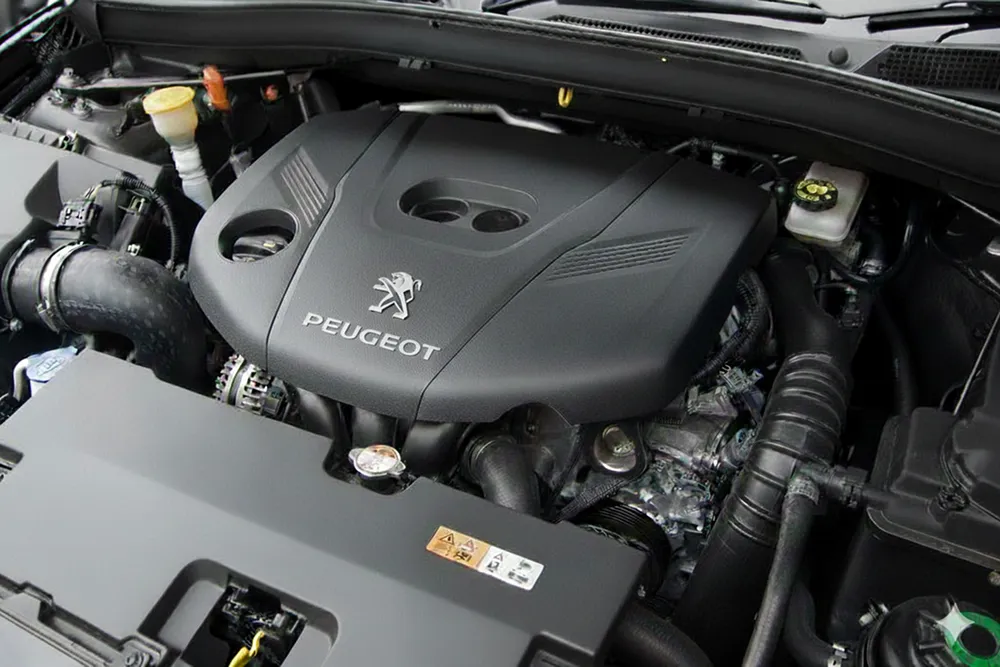
All production years (2014–2021) meet Euro 6b/c standards (VCA UK Type Approval #VCA/EMS/8901).
The Peugeot 5GN (EP6FDTR) is a 1,598 cc inline‑four turbocharged petrol engineered for high-performance applications (2014-2021). It combines BMW-derived Valvetronic variable valve lift with direct injection and a twin-scroll turbocharger to deliver exceptional throttle response and high specific output. Designed to meet Euro 6 standards, it incorporates a GPF for particulate control.
| Parameter | Value | Source |
|---|---|---|
Displacement | 1,598 cc | |
Fuel type | Petrol | |
Configuration | Inline‑4, DOHC, 16‑valve | |
Aspiration | Turbocharged | |
Bore × stroke | 77.0 mm × 85.8 mm | |
Power output | 184 kW (250 PS) | |
Torque | 330 Nm @ 1,900 rpm | |
Fuel system | Direct injection with BMW Valvetronic (Bosch HDEV5) | |
Emissions standard | Euro 6b/c | |
Compression ratio | 9.2:1 | |
Cooling system | Water‑cooled | |
Turbocharger | Single twin‑scroll turbo (Mitsubishi Heavy Industries) | |
Timing system | Chain‑driven (front-mounted) | |
Oil type | Peugeot 9736.B2 (SAE 5W‑30) | |
Dry weight | 132 kg |
The Peugeot 5GN (EP6FDTR) was used across Peugeot's EMP2 platform with transverse mounting. This engine was exclusively fitted to high-performance 'R' and '270' variants and received platform-specific adaptations-reinforced engine mounts in the RCZ R and revised cooling for the 308 GTi 270. All adaptations are documented in OEM technical bulletins.
The 5GN (EP6FDTR)'s primary reliability risk is timing chain tensioner wear, with elevated incidence in vehicles subjected to aggressive driving or extended oil change intervals. Peugeot internal service data indicates a notable failure rate after 80,000 km in high-performance applications, while general owner reports frequently cite the resulting rattle and potential for catastrophic failure. Use of incorrect oil viscosity or infrequent changes accelerates wear, making adherence to the specified 5W-30 oil and service schedule critical.
Analysis derived from Peugeot technical bulletins (2014-2021) and owner-reported failure data (2016-2023). Repair procedures should follow manufacturer guidelines.
The most common questions about engine codes, what they mean, how to find them and how this database works
The 5GN (EP6FDTR) is a high-strung performance engine. Its biggest weakness is the timing chain tensioner, which requires proactive replacement. With strict adherence to oil changes using 5W-30, timely tensioner replacement, and gentle warm-up procedures, these engines can be reliable. However, neglect or aggressive use without proper maintenance will lead to expensive failures.
The most frequent issues are timing chain tensioner wear causing rattle, failure of the BMW-sourced Valvetronic actuator leading to power loss, high-pressure fuel pump failures, and turbocharger wastegate actuator faults. These are well-documented in Peugeot service information and are common to high-performance variants of this engine family.
This 250 PS 1.6L turbo petrol engine was used exclusively in Peugeot's highest-performance models: the RCZ R (2014-2015) and the 308 GTi 270 (2015-2021). It was not used in any other Peugeot model or trim level.
Yes, but with caution. The 5GN (EP6FDTR) is already near the limit of its stock internals. A conservative ECU remap can yield +20-30 kW, but significant gains require upgraded internals (pistons, rods) and supporting mods (fuel pump, intercooler). The timing chain and tensioner must be in perfect condition before any tuning.
Expect combined fuel economy of approximately 7.5-8.5 L/100km (38-33 mpg UK) in a Peugeot 308 GTi 270. Real-world figures are highly dependent on driving style; aggressive driving will see consumption rise significantly, often exceeding 12 L/100km. The official figures are very optimistic for spirited use.
Yes. The 5GN (EP6FDTR) is an interference engine. If the timing chain were to fail or jump due to tensioner wear, piston-to-valve contact is highly likely, resulting in severe internal engine damage requiring a complete rebuild or replacement.
Peugeot mandates a 5W-30 synthetic oil meeting their specific 9736.B2 standard (or equivalent ACEA C2). Using the correct low-SAPS (Sulphated Ash, Phosphorus, Sulphur) oil is critical for the longevity of the GPF and the Valvetronic system. Change intervals should not exceed 15,000 km or 1 year, and more frequent changes are recommended for performance use.
Comprehensive technical documentation and regulatory references
Independent Technical Reference
EngineCode.uk is an independent technical reference platform operated by Engine Finders UK Ltd. We are not affiliated with PEUGEOT or any other manufacturer. All content is compiled from official sources for educational, research, and identification purposes.
Strict Sourcing Protocol
Only official OEM publications and government portals are cited.
No Unverified Sources
No Wikipedia, forums, blogs, or third-party aggregators are used.
Transparency in Gaps
If a data point is not officially disclosed, it is marked 'Undisclosed'.
Regulatory Stability
EU regulations are referenced using CELEX identifiers for long-term stability.
PEUGEOT Official Site
Owner literature, service manuals, technical releases, and plant documentation.
EUR-Lex
EU emissions and type-approval regulations (e.g., CELEX:32007R0715, CELEX:32017R1151).
GOV.UK: Vehicle Approval & V5C
UK vehicle approval processes, import rules, and MoT guidance.
DVLA: Engine Changes & MoT
Official guidance on engine swaps and inspection implications.
Vehicle Certification Agency (VCA)
UK type-approval authority for automotive products.
Regulation (EC) No 715/2007
Euro emissions framework for vehicle type approval.
Commission Regulation (EU) 2017/1151
WLTP and RDE testing procedures for emissions certification.
GOV.UK: Vehicle Approval
UK compliance and certification requirements for imported and modified vehicles.
VCA Certification Portal
Type-approval guidance and documentation.
Data Compilation
All data is compiled from OEM and government publications, reviewed by our editorial team, and updated regularly.
Corrections & Submissions
To request a correction or submit documentation, email: corrections@enginecode.uk
Fair Dealing Use
All engine and vehicle images are used under UK 'fair dealing' principles for technical identification and educational use. Rights remain with their respective owners.
Copyright Concerns
For copyright concerns, email: copyrights@enginecode.uk
GDPR Compliance
EngineCode.uk complies with UK GDPR. We do not collect personal data unless explicitly provided.
Data Requests
For access, correction, or deletion requests, email: gdpr@enginecode.uk
Trademark Notice
All trademarks, logos, and engine codes are the property of their respective owners. Use on this site is strictly for reference and identification.
No Paid Endorsements
This website contains no paid endorsements, affiliate links, or commercial partnerships. We do not sell parts or services.
Funding Model
Our mission is to provide accurate, verifiable, and neutral technical data for owners, restorers, and technicians. This site is self-funded.
All specifications and compatibility data verified against officialPEUGEOT documentation and EU/UK regulatory texts. Where official data is unavailable, entries are marked “Undisclosed”.
All external links open in new tabs. Please verify current availability of resources.