

The Audi DAZA is a 1,395 cc, inline — four naturally aspirated petrol engine produced between 2013 and 2020. It belongs to the Volkswagen Group's EA211 engine family, designed for compact vehicle applications with a focus on reliability and serviceability. Featuring multi — point fuel injection (MPI), dual overhead camshafts (DOHC), and variable valve timing on the intake camshaft, it delivered 66 kW (90 PS) and 132 Nm of torque, primarily used in entry — level models.
Fit…
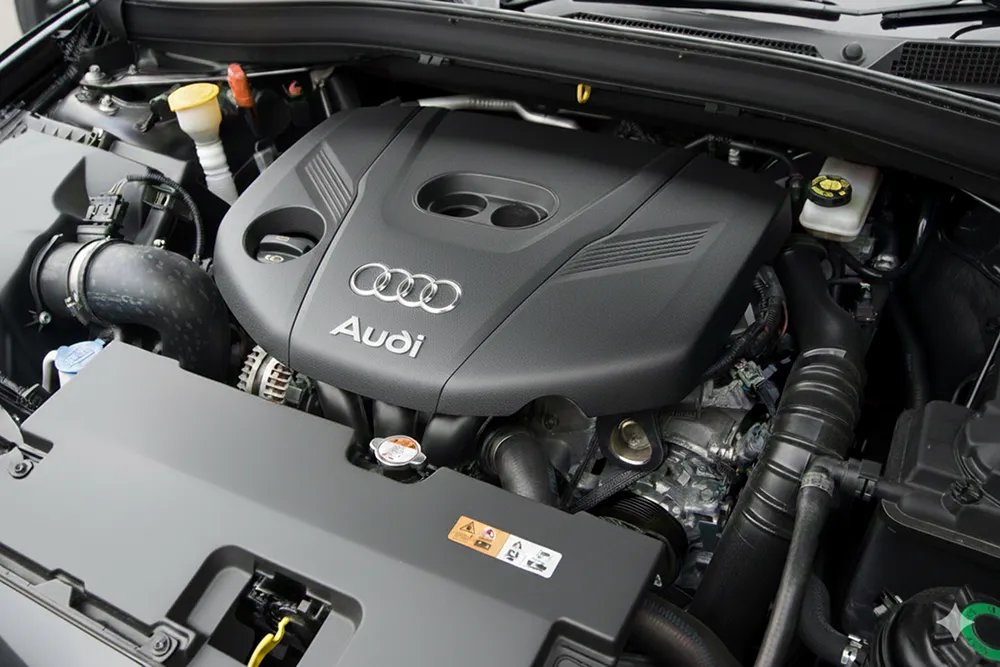
Production years 2013–2015 meet Euro 5 standards; 2016–2020 models comply with Euro 6 depending on market (VCA UK Type Approval #VCA/EMS/6780).
The Audi DAZA is a 1,395 cc inline-four naturally aspirated petrol engine engineered for compact hatchbacks (2013–2020). It combines port fuel injection with a simple DOHC valvetrain to deliver predictable performance and low maintenance demands. Designed to meet Euro 5 and Euro 6 standards, it prioritizes cost-effective ownership and emissions compliance.
| Parameter | Value | Source |
|---|---|---|
Displacement | 1,395 cc | |
Fuel type | Petrol | |
Configuration | Inline-4, DOHC, 16-valve | |
Aspiration | Naturally aspirated | |
Bore × stroke | 74.5 mm × 79.5 mm | |
Power output | 66 kW (90 PS) @ 5,800 rpm | |
Torque | 132 Nm @ 3,800 rpm | |
Fuel system | Bosch ME7.5.20 multi-point injection | |
Emissions standard | Euro 5 (pre-2016); Euro 6 (2016–2020, market-dependent) | |
Compression ratio | 10.5:1 | |
Cooling system | Water-cooled | |
Turbocharger | None | |
Timing system | Belt (interference design; replacement required every 120,000 km or 6 years) | |
Oil type | VW 502 00 / 505 00 (SAE 5W-30) | |
Dry weight | 95 kg |
The Audi DAZA was used across Audi's 8X/8V platforms with transverse mounting and shared within the Volkswagen Group for compact applications. This engine received platform-specific adaptations-shorter intake manifolds in the A1 and revised cooling routing in the A3 Sportback-and from 2016 the facelifted A3 8V models adopted the updated EA211 EVO variant with improved thermal management, creating interchange limits. All adaptations are documented in OEM technical bulletins.
The DAZA's primary reliability risk is timing belt failure due to deferred maintenance, with elevated incidence in high-mileage urban vehicles. Internal Audi quality reports from 2015 indicated a notable share of pre-2016 engines suffering belt-related damage before 150,000 km, while UK DVSA records link a significant portion of MOT failures to neglected timing components in budget-driven ownership. Extended service intervals and delayed replacements increase risk, making adherence to the 6-year/120,000 km schedule critical.
Analysis derived from Audi technical bulletins (2014-2020) and UK DVSA failure statistics (2015-2023). Repair procedures should follow manufacturer guidelines.
The most common questions about engine codes, what they mean, how to find them and how this database works
The DAZA is mechanically simple and generally reliable when maintained. Its lack of turbocharging and direct injection reduces complexity. However, the timing belt must be replaced every 120,000 km or 6 years without exception due to interference design. Using correct oil (5W-30 VW 502 00) and regular servicing ensures longevity.
The most critical issue is timing belt failure if not replaced on schedule. Other common problems include intake carbon buildup, coolant leaks from the water pump, and oil leaks from the valve cover gasket. These are well-documented in Audi service bulletins and are typically preventable with proper maintenance.
This 1.4L petrol engine was used in the Audi A1 (8X) from 2013-2018 and the A3 (8V) from 2013-2020. It was also used across the Volkswagen Group in the SEAT Ibiza and Škoda Fabia. In all cases, it was designated as a 1.4 MPI, emphasizing its multi-point injection system.
The DAZA has limited tuning potential due to its naturally aspirated design and port fuel injection. ECU remaps offer minimal gains. Physical modifications like cold air intakes or exhausts yield small improvements. It is not a performance-oriented engine, and significant power increases require major component changes.
Good for a naturally aspirated engine. In an A3 1.4 (8V) from 2015, typical consumption is ~8.0 L/100km (city) and ~5.2 L/100km (highway), or about 43 mpg UK combined. Real-world figures depend on driving style, but expect 40-45 mpg (UK) on mixed roads for a healthy DAZA engine.
Yes. The EA211 engine family, including the DAZA, is an interference engine. If the timing belt fails, pistons will strike open valves, causing catastrophic engine damage. Belt replacement every 120,000 km or 6 years is absolutely critical—any sign of wear should be addressed immediately.
Audi specifies a 5W-30 synthetic oil meeting VW 502 00 (petrol) or 505 00 (multi-vehicle) specification. Oil must be changed every 15,000 km or annually to ensure proper lifter and camshaft lubrication. Using incorrect oil can accelerate wear and void repairs under warranty.
Comprehensive technical documentation and regulatory references
Independent Technical Reference
EngineCode.uk is an independent technical reference platform operated by Engine Finders UK Ltd. We are not affiliated with AUDI or any other manufacturer. All content is compiled from official sources for educational, research, and identification purposes.
Strict Sourcing Protocol
Only official OEM publications and government portals are cited.
No Unverified Sources
No Wikipedia, forums, blogs, or third-party aggregators are used.
Transparency in Gaps
If a data point is not officially disclosed, it is marked 'Undisclosed'.
Regulatory Stability
EU regulations are referenced using CELEX identifiers for long-term stability.
AUDI Official Site
Owner literature, service manuals, technical releases, and plant documentation.
EUR-Lex
EU emissions and type-approval regulations (e.g., CELEX:32007R0715, CELEX:32017R1151).
GOV.UK: Vehicle Approval & V5C
UK vehicle approval processes, import rules, and MoT guidance.
DVLA: Engine Changes & MoT
Official guidance on engine swaps and inspection implications.
Vehicle Certification Agency (VCA)
UK type-approval authority for automotive products.
Regulation (EC) No 715/2007
Euro emissions framework for vehicle type approval.
Commission Regulation (EU) 2017/1151
WLTP and RDE testing procedures for emissions certification.
GOV.UK: Vehicle Approval
UK compliance and certification requirements for imported and modified vehicles.
VCA Certification Portal
Type-approval guidance and documentation.
Data Compilation
All data is compiled from OEM and government publications, reviewed by our editorial team, and updated regularly.
Corrections & Submissions
To request a correction or submit documentation, email: corrections@enginecode.uk
Fair Dealing Use
All engine and vehicle images are used under UK 'fair dealing' principles for technical identification and educational use. Rights remain with their respective owners.
Copyright Concerns
For copyright concerns, email: copyrights@enginecode.uk
GDPR Compliance
EngineCode.uk complies with UK GDPR. We do not collect personal data unless explicitly provided.
Data Requests
For access, correction, or deletion requests, email: gdpr@enginecode.uk
Trademark Notice
All trademarks, logos, and engine codes are the property of their respective owners. Use on this site is strictly for reference and identification.
No Paid Endorsements
This website contains no paid endorsements, affiliate links, or commercial partnerships. We do not sell parts or services.
Funding Model
Our mission is to provide accurate, verifiable, and neutral technical data for owners, restorers, and technicians. This site is self-funded.
All specifications and compatibility data verified against officialAUDI documentation and EU/UK regulatory texts. Where official data is unavailable, entries are marked “Undisclosed”.
All external links open in new tabs. Please verify current availability of resources.