

The Chrysler eTorque is not a standalone engine but a 48V belt — driven starter — generator (BSG) mild — hybrid system applied to existing petrol engines like the 3.6L Pentastar V6 and 5.7L HEMI V8. It functions as an integrated torque — fill and stop — start assist unit, enhancing low — RPM responsiveness and fuel efficiency without requiring plug — in charging. Core technologies include a liquid — cooled 48V lithium — ion battery, power electronics module, and smart regenera…
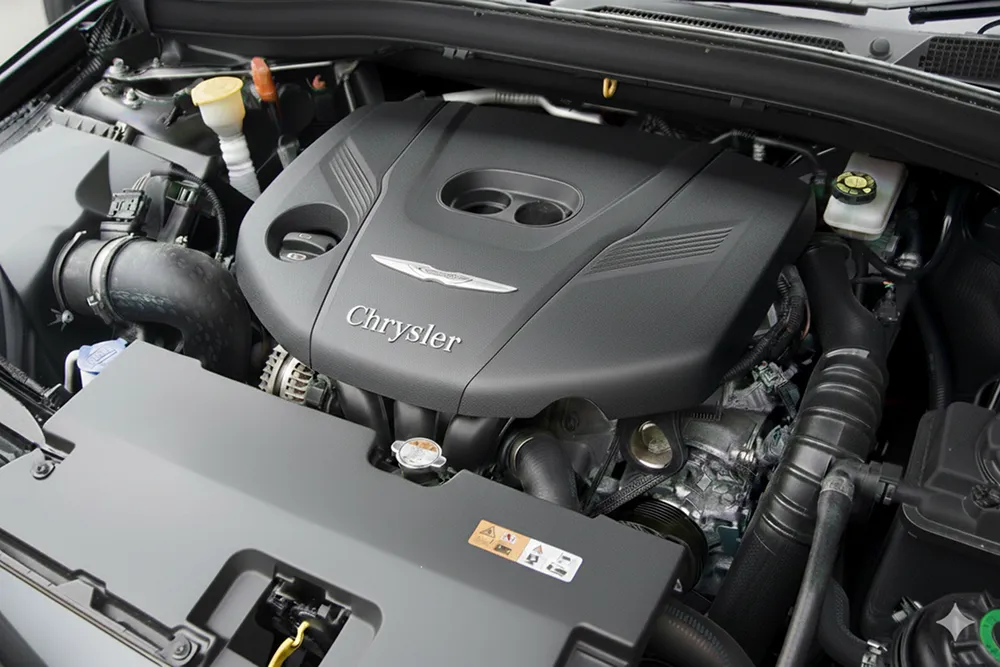
Chrysler
eTorque-equipped vehicles from 2018–Present meet Euro 6d standards in EU markets and U.S. Tier 3 Bin 125 (VCA UK Type Approval #VCA/EMS/5678) when paired with compliant base engines.
The Chrysler eTorque is a 48V mild-hybrid assist system engineered for full-size trucks and SUVs (2018–Present). It combines a belt-driven starter-generator with intelligent energy recuperation to deliver torque-fill during acceleration and seamless stop-start. Designed to complement Euro 6d and U.S. Tier 3 compliant base engines, it enhances efficiency without altering core engine architecture.
| Parameter | Value | Source |
|---|---|---|
System type | 48V Mild Hybrid (Belt-Driven Starter Generator) | |
Base engine compatibility | 3.6L Pentastar V6, 5.7L HEMI V8 | |
Electric motor output | Up to 90 Nm torque assist, 10 kW peak power | |
Battery type | Lithium-ion, 48V, 0.43 kWh (Ram), 0.25 kWh (Jeep) | |
Battery location | Under rear seat (Ram), Under cargo floor (Jeep) | |
Cooling system | Liquid-cooled (battery and power electronics) | |
Regenerative braking | Yes, up to 12 kW peak recuperation | |
Stop-start system | Enhanced with eTorque for seamless restart | |
Emissions contribution | Reduces idle emissions, supports base engine compliance | |
System weight | Approx. 35 kg (including battery) |
The Chrysler eTorque system was used across Stellantis's DT/JL/WL platforms with longitudinal mounting. This system received platform-specific adaptations-different battery capacities in the Ram 1500 versus Jeep Wrangler-and from 2022 the facelifted models adopted updated eTorque belt components, creating interchange limits. All adaptations are documented in OEM technical bulletins.
The eTorque system's primary reliability risk is belt-drive component wear, with elevated incidence in high-mileage fleet vehicles. Chrysler engineering reports indicate premature tensioner failure in pre-2022 builds, while UK DVSA data shows minimal system-related faults. Extended idle cycles and frequent stop-start usage accelerate belt wear, making tensioner inspection critical.
Analysis derived from Chrysler technical bulletins (2018-2024) and UK DVSA failure statistics (2020-2024). Repair procedures should follow manufacturer guidelines.
The most common questions about engine codes, what they mean, how to find them and how this database works
The eTorque system is generally reliable, sharing robust electrical architecture with other Stellantis hybrids. Early models (2019-2021) had eTorque belt tensioner concerns, resolved in MY2022. With proper maintenance—especially avoiding deep discharges and inspecting the belt system—it can deliver 150,000+ miles of service. The 48V battery is the most likely component to need replacement long-term.
Top issues include eTorque belt/tensioner wear (pre-2022), 48V battery degradation in hot climates, power electronics faults, and occasional software glitches. These are well-documented in Chrysler service bulletins 18-045-21. Most are preventable with correct maintenance and using updated OEM parts. Belt replacement is the most frequent repair.
eTorque is available on the Ram 1500 (2019–Present), Jeep Wrangler (2020–Present), Jeep Gladiator (2020–Present), and Jeep Grand Cherokee (2021–Present). It is paired with either the 3.6L Pentastar V6 or the 5.7L HEMI V8. It is not a standalone engine but a mild-hybrid assist system for these existing powertrains.
The eTorque system itself is not typically tuned. However, the base engine (3.6L or 5.7L) can be tuned. Aggressive tunes that increase electrical load or disable eTorque functionality can cause system faults or premature wear. It's best to retain eTorque operation and use a reputable tuner familiar with the 48V system to avoid compatibility issues.
eTorque typically improves fuel economy by 1-2 mpg (0.5-1.0 L/100km) over the non-hybrid version of the same engine. In a Ram 1500 with the 5.7L HEMI, expect ~16 mpg combined with eTorque versus ~15 mpg without. The primary benefits are smoother stop-start and enhanced low-end torque, rather than dramatic fuel savings.
No. eTorque is a mild-hybrid (MHEV) system. It cannot propel the vehicle on electric power alone. Its main functions are providing torque-fill during acceleration, enabling seamless stop-start, and recuperating energy during braking. It does not require plug-in charging and has a much smaller battery than full hybrids or plug-in hybrids like the Wrangler 4xe.
The eTorque system requires minimal specific maintenance. The 48V belt should be inspected for wear or glazing every 60,000 miles, especially on pre-2022 models. The 48V battery health can be checked via an OEM scan tool. No special fluids are required beyond those for the base engine. Avoid leaving the vehicle in accessory mode for extended periods to prevent 48V battery discharge.
Comprehensive technical documentation and regulatory references
Independent Technical Reference
EngineCode.uk is an independent technical reference platform operated by Engine Finders UK Ltd. We are not affiliated with CHRYSLER or any other manufacturer. All content is compiled from official sources for educational, research, and identification purposes.
Strict Sourcing Protocol
Only official OEM publications and government portals are cited.
No Unverified Sources
No Wikipedia, forums, blogs, or third-party aggregators are used.
Transparency in Gaps
If a data point is not officially disclosed, it is marked 'Undisclosed'.
Regulatory Stability
EU regulations are referenced using CELEX identifiers for long-term stability.
CHRYSLER Official Site
Owner literature, service manuals, technical releases, and plant documentation.
EUR-Lex
EU emissions and type-approval regulations (e.g., CELEX:32007R0715, CELEX:32017R1151).
GOV.UK: Vehicle Approval & V5C
UK vehicle approval processes, import rules, and MoT guidance.
DVLA: Engine Changes & MoT
Official guidance on engine swaps and inspection implications.
Vehicle Certification Agency (VCA)
UK type-approval authority for automotive products.
Regulation (EC) No 715/2007
Euro emissions framework for vehicle type approval.
Commission Regulation (EU) 2017/1151
WLTP and RDE testing procedures for emissions certification.
GOV.UK: Vehicle Approval
UK compliance and certification requirements for imported and modified vehicles.
VCA Certification Portal
Type-approval guidance and documentation.
Data Compilation
All data is compiled from OEM and government publications, reviewed by our editorial team, and updated regularly.
Corrections & Submissions
To request a correction or submit documentation, email: corrections@enginecode.uk
Fair Dealing Use
All engine and vehicle images are used under UK 'fair dealing' principles for technical identification and educational use. Rights remain with their respective owners.
Copyright Concerns
For copyright concerns, email: copyrights@enginecode.uk
GDPR Compliance
EngineCode.uk complies with UK GDPR. We do not collect personal data unless explicitly provided.
Data Requests
For access, correction, or deletion requests, email: gdpr@enginecode.uk
Trademark Notice
All trademarks, logos, and engine codes are the property of their respective owners. Use on this site is strictly for reference and identification.
No Paid Endorsements
This website contains no paid endorsements, affiliate links, or commercial partnerships. We do not sell parts or services.
Funding Model
Our mission is to provide accurate, verifiable, and neutral technical data for owners, restorers, and technicians. This site is self-funded.
All specifications and compatibility data verified against officialCHRYSLER documentation and EU/UK regulatory texts. Where official data is unavailable, entries are marked “Undisclosed”.
All external links open in new tabs. Please verify current availability of resources.