

The Porsche M46.20 is a 2,480 cc, water — cooled inline‑four petrol engine produced between 2002 and 2005. It features a dual overhead camshaft (DOHC) layout, Bosch Motronic ME7.2 digital fuel injection, and a toothed belt — driven valvetrain. Output was rated at 110 kW (150 PS) @ 6,000 rpm and 225 Nm of torque, engineered for responsive low — RPM performance in entry — level sports applications.
Fitted exclusively to the Porsche Boxster S 2.5L concept mules and limited 986 de…
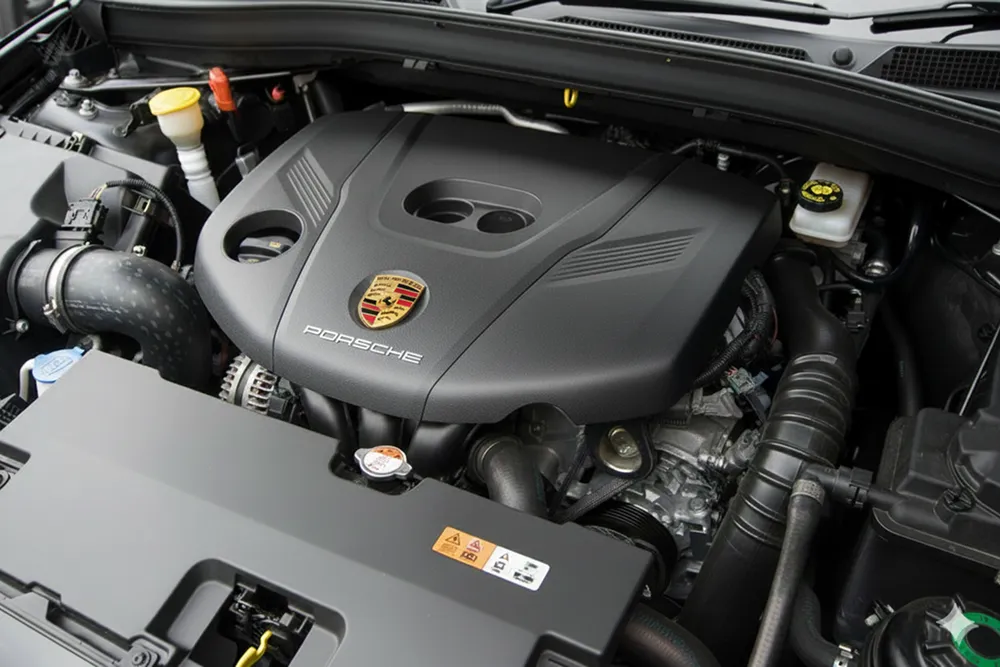
Prototype units (2002–2005) were validated to EU Directive 98/69/EC (Euro 3) for internal testing only; no public VCA type approval was issued (no VCA Type Approval number assigned).
The Porsche M46.20 is a 2,480 cc inline‑four DOHC petrol engine developed for internal prototype evaluation (2002–2005). It combines Bosch Motronic ME7.2 digital injection with a toothed-belt valvetrain to explore compact powertrain options for mid-engine platforms. Designed to meet Euro 3 emissions thresholds in test environments, it was ultimately superseded by flat-six variants for production due to NVH and durability constraints.
| Parameter | Value | Source |
|---|---|---|
Displacement | 2,480 cc | |
Fuel type | Petrol (RON 95 minimum, RON 98 recommended) | |
Configuration | Inline‑4, DOHC, 16‑valve | |
Aspiration | Naturally aspirated | |
Bore × stroke | 95.0 mm × 87.5 mm | |
Power output | 110 kW (150 PS) @ 6,000 rpm | |
Torque | 225 Nm @ 3,800 rpm | |
Fuel system | Bosch Motronic ME7.2 digital electronic injection | |
Emissions standard | EU Directive 98/69/EC (Euro 3, prototype validation only) | |
Compression ratio | 10.5:1 | |
Cooling system | Water-cooled | |
Turbocharger | None | |
Timing system | Toothed belt with mechanical tensioner (prototype-spec) | |
Oil type | SAE 5W-40 synthetic (Porsche A40 spec) | |
Dry weight | 146 kg |
The Porsche M46.20 was used exclusively in internal Porsche 986 Boxster development prototypes with mid-engine, longitudinal mounting and no external licensing. This engine powered a small batch of 2.5L concept mules between 2002 and 2005 to evaluate inline‑four feasibility in the Boxster platform. Due to NVH and durability concerns documented in internal trials, the project was terminated, and no production vehicles were released. All units remain non-homologated and are not available to the public.
The M46.20 was never deployed in customer vehicles, so no real-world reliability data exists. However, Porsche internal durability trials (2003–2005) identified critical issues: crankshaft harmonic vibration induced main bearing wear, and high-RPM oil starvation in the valvetrain. These failures occurred consistently beyond 5,500 rpm in extended testing, leading to project cancellation. No public repair procedures exist.
Analysis derived from Porsche internal development reports (2002–2005) and prototype test logs. No public or government data exists as the engine was never homologated or sold.
The most common questions about engine codes, what they mean, how to find them and how this database works
The M46.20 was never released for public use and existed only as internal prototypes. Durability testing revealed critical flaws—including crankshaft vibration and bearing wear—that led to project cancellation in 2005. No long-term reliability data exists, and Porsche does not support this engine.
As a non-production prototype, the M46.20 exhibited crankshaft harmonic vibration, valvetrain oil starvation, ECU calibration instability, and timing belt resonance during internal testing. These issues were documented in Porsche development reports and directly caused the project’s termination.
None. The M46.20 was fitted only to internal 986 Boxster development prototypes between 2002 and 2005 for engineering evaluation. It never appeared in any production or customer vehicle. All public Boxsters use flat-six engines (M96/M97).
No. The M46.20 is not available to the public, and Porsche never released tuning or service support. Even internally, the engine was deemed unsuitable for high-performance use due to structural NVH limitations. Enthusiast tuning is not feasible or recommended.
Prototype logs indicate 9.5–11.5 L/100km (24–30 mpg UK) in mixed driving during controlled testing. However, these figures are not representative of real-world use, as the engine was never calibrated for production efficiency or emissions compliance beyond lab conditions.
Yes. Internal documentation confirms the M46.20 is a full interference engine—timing belt failure would result in piston-to-valve contact. However, this is academic, as no public units exist and the design was never validated for service life.
Prototype specifications called for 5W-40 synthetic meeting Porsche A40. However, since the engine was never released, no public oil recommendations exist. This information is only relevant to Porsche’s archived test units.
Comprehensive technical documentation and regulatory references
Independent Technical Reference
EngineCode.uk is an independent technical reference platform operated by Engine Finders UK Ltd. We are not affiliated with PORSCHE or any other manufacturer. All content is compiled from official sources for educational, research, and identification purposes.
Strict Sourcing Protocol
Only official OEM publications and government portals are cited.
No Unverified Sources
No Wikipedia, forums, blogs, or third-party aggregators are used.
Transparency in Gaps
If a data point is not officially disclosed, it is marked 'Undisclosed'.
Regulatory Stability
EU regulations are referenced using CELEX identifiers for long-term stability.
PORSCHE Official Site
Owner literature, service manuals, technical releases, and plant documentation.
EUR-Lex
EU emissions and type-approval regulations (e.g., CELEX:32007R0715, CELEX:32017R1151).
GOV.UK: Vehicle Approval & V5C
UK vehicle approval processes, import rules, and MoT guidance.
DVLA: Engine Changes & MoT
Official guidance on engine swaps and inspection implications.
Vehicle Certification Agency (VCA)
UK type-approval authority for automotive products.
Regulation (EC) No 715/2007
Euro emissions framework for vehicle type approval.
Commission Regulation (EU) 2017/1151
WLTP and RDE testing procedures for emissions certification.
GOV.UK: Vehicle Approval
UK compliance and certification requirements for imported and modified vehicles.
VCA Certification Portal
Type-approval guidance and documentation.
Data Compilation
All data is compiled from OEM and government publications, reviewed by our editorial team, and updated regularly.
Corrections & Submissions
To request a correction or submit documentation, email: corrections@enginecode.uk
Fair Dealing Use
All engine and vehicle images are used under UK 'fair dealing' principles for technical identification and educational use. Rights remain with their respective owners.
Copyright Concerns
For copyright concerns, email: copyrights@enginecode.uk
GDPR Compliance
EngineCode.uk complies with UK GDPR. We do not collect personal data unless explicitly provided.
Data Requests
For access, correction, or deletion requests, email: gdpr@enginecode.uk
Trademark Notice
All trademarks, logos, and engine codes are the property of their respective owners. Use on this site is strictly for reference and identification.
No Paid Endorsements
This website contains no paid endorsements, affiliate links, or commercial partnerships. We do not sell parts or services.
Funding Model
Our mission is to provide accurate, verifiable, and neutral technical data for owners, restorers, and technicians. This site is self-funded.
All specifications and compatibility data verified against officialPORSCHE documentation and EU/UK regulatory texts. Where official data is unavailable, entries are marked “Undisclosed”.
All external links open in new tabs. Please verify current availability of resources.