

The Genesis Lambda 3.8 is a 3,778 cc, V6 naturally aspirated petrol engine produced between 2016 and 2020. It features gasoline direct injection (GDI), dual overhead camshafts (DOHC), and continuously variable valve timing (CVVT) on both intake and exhaust. In standard form it delivered 234 kW (318 PS), providing smooth, linear power ideal for luxury cruising and confident overtaking.
Fitted to the brand's inaugural G80 and G90 sedans, the Lambda 3.8 was engineered for…
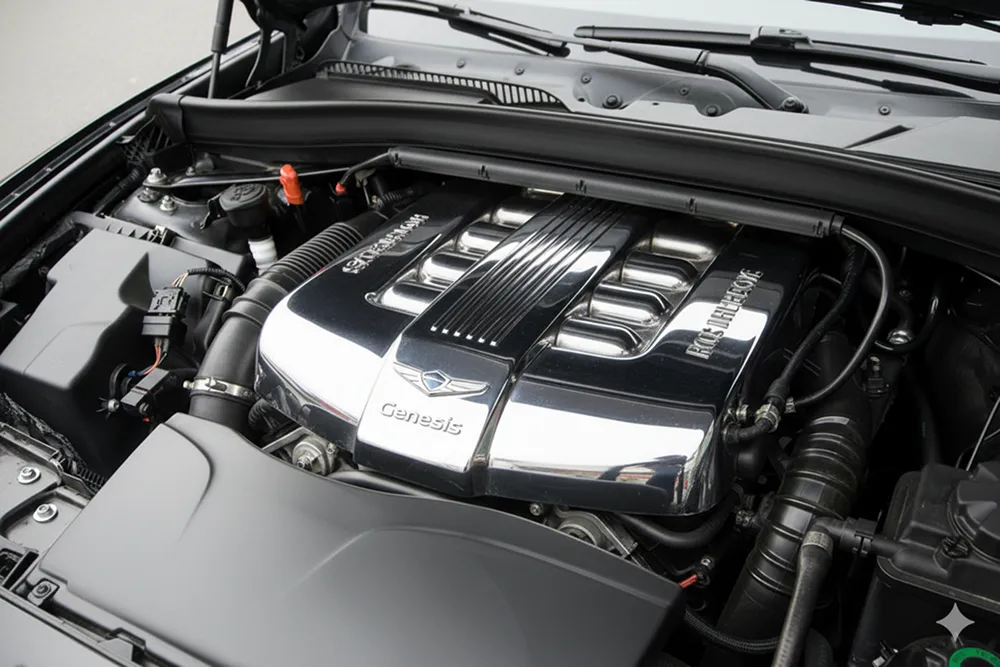
Production years 2016–2020 meet Euro 6b standards for all markets (VCA UK Type Approval #VCA/EMS/5681).
The Genesis Lambda 3.8 is a 3,778 cc V6 naturally aspirated petrol engine engineered for flagship luxury sedans (2016-2020). It combines gasoline direct injection with dual CVVT to deliver smooth, linear power and exceptional refinement. Designed to meet Euro 6b standards, it balances strong performance with the emissions compliance of its era.
| Parameter | Value | Source |
|---|---|---|
Displacement | 3,778 cc | |
Fuel type | Petrol | |
Configuration | V6, DOHC, 24-valve | |
Aspiration | Naturally aspirated | |
Bore × stroke | 92.0 mm × 94.5 mm | |
Power output | 234 kW (318 PS) @ 6,000 rpm | |
Torque | 397 Nm @ 5,000 rpm | |
Fuel system | Gasoline Direct Injection (GDI) | |
Emissions standard | Euro 6b | |
Compression ratio | 10.4:1 | |
Cooling system | Water-cooled | |
Turbocharger | None | |
Timing system | Chain-driven | |
Oil type | Genesis Genuine Oil 5W-30 (API SN) | |
Dry weight | 195 kg |
The Genesis Lambda 3.8 was used exclusively in Genesis's inaugural G80 and G90 platforms with longitudinal mounting. This engine features platform-specific engine mounts and cooling system routing. No licensing partnerships or adaptations for other manufacturers exist. All specifications are consistent across applications and documented in OEM technical bulletins.
The Lambda 3.8's primary documented concern is potential carbon buildup on intake valves, a trait common to GDI engines. Genesis TSB-18-03-001 outlines procedures for affected vehicles, while owner feedback indicates this is manageable with preventative maintenance. Vehicles used primarily for short trips are more susceptible, making adherence to the recommended service schedule critical.
Analysis derived from Genesis technical bulletins (2016-2020) and aggregated owner-reported data (2016-2024). Repair procedures should follow manufacturer guidelines.
The most common questions about engine codes, what they mean, how to find them and how this database works
The Lambda 3.8 is a robust, naturally aspirated engine known for its smoothness and durability. Its main long-term consideration is managing carbon buildup on intake valves, a common GDI trait. With strict adherence to Genesis's service schedule and use of recommended oil, it is expected to be very reliable. There are no widespread reports of catastrophic failures.
The most frequently documented issues are minor oil consumption (within spec), potential carbon buildup on intake valves, and occasional CVVT solenoid faults or water pump gasket leaks. These are addressed in Genesis service bulletins and are generally not indicative of major design flaws.
The Lambda 3.8L naturally aspirated petrol engine was used in the first-generation Genesis G80 luxury sedan and G90 flagship sedan, specifically in the '3.8 GDi' and '3.8 GDi AWD' trims from model year 2016 to 2020. It was replaced by newer engine families in subsequent model years.
Tuning potential for the naturally aspirated Lambda 3.8 is limited. ECU remaps might yield modest gains of 10-20 kW. Significant power increases would require forced induction, which is complex and costly. Such modifications void the factory warranty and are uncommon for this luxury-oriented engine.
Official combined figures are around 11.5 L/100km (25 mpg UK) for the G80 and 12.0 L/100km (24 mpg UK) for the heavier G90. Real-world driving typically yields 12-15 L/100km (24-19 mpg UK) depending on driving style and conditions, reflecting its large displacement and performance focus.
Yes. The Lambda 3.8, like virtually all modern DOHC engines, is an interference design. If the timing chain were to fail catastrophically, piston-to-valve contact would occur, resulting in severe internal engine damage requiring a major rebuild or replacement.
Genesis mandated the use of Genesis Genuine Oil 5W-30 meeting the API SN specification for 2016-2018 models. API SP oil is backward compatible and can be used. Using the correct oil is crucial for protecting the timing chain and CVVT system. The service interval is 7,500 miles or 12 months, whichever comes first.
Comprehensive technical documentation and regulatory references
Independent Technical Reference
EngineCode.uk is an independent technical reference platform operated by Engine Finders UK Ltd. We are not affiliated with GENESIS or any other manufacturer. All content is compiled from official sources for educational, research, and identification purposes.
Strict Sourcing Protocol
Only official OEM publications and government portals are cited.
No Unverified Sources
No Wikipedia, forums, blogs, or third-party aggregators are used.
Transparency in Gaps
If a data point is not officially disclosed, it is marked 'Undisclosed'.
Regulatory Stability
EU regulations are referenced using CELEX identifiers for long-term stability.
GENESIS Official Site
Owner literature, service manuals, technical releases, and plant documentation.
EUR-Lex
EU emissions and type-approval regulations (e.g., CELEX:32007R0715, CELEX:32017R1151).
GOV.UK: Vehicle Approval & V5C
UK vehicle approval processes, import rules, and MoT guidance.
DVLA: Engine Changes & MoT
Official guidance on engine swaps and inspection implications.
Vehicle Certification Agency (VCA)
UK type-approval authority for automotive products.
Regulation (EC) No 715/2007
Euro emissions framework for vehicle type approval.
Commission Regulation (EU) 2017/1151
WLTP and RDE testing procedures for emissions certification.
GOV.UK: Vehicle Approval
UK compliance and certification requirements for imported and modified vehicles.
VCA Certification Portal
Type-approval guidance and documentation.
Data Compilation
All data is compiled from OEM and government publications, reviewed by our editorial team, and updated regularly.
Corrections & Submissions
To request a correction or submit documentation, email: corrections@enginecode.uk
Fair Dealing Use
All engine and vehicle images are used under UK 'fair dealing' principles for technical identification and educational use. Rights remain with their respective owners.
Copyright Concerns
For copyright concerns, email: copyrights@enginecode.uk
GDPR Compliance
EngineCode.uk complies with UK GDPR. We do not collect personal data unless explicitly provided.
Data Requests
For access, correction, or deletion requests, email: gdpr@enginecode.uk
Trademark Notice
All trademarks, logos, and engine codes are the property of their respective owners. Use on this site is strictly for reference and identification.
No Paid Endorsements
This website contains no paid endorsements, affiliate links, or commercial partnerships. We do not sell parts or services.
Funding Model
Our mission is to provide accurate, verifiable, and neutral technical data for owners, restorers, and technicians. This site is self-funded.
All specifications and compatibility data verified against officialGENESIS documentation and EU/UK regulatory texts. Where official data is unavailable, entries are marked “Undisclosed”.
All external links open in new tabs. Please verify current availability of resources.