

The Jeep eTorque is a mild — hybrid system paired with 2.0L turbo petrol or 3.6L V6 petrol engines, produced between 2018 and 2023. It features a 48V belt — driven starter — generator (BSG) that provides torque — fill, engine stop — start, and energy recuperation, delivering supplemental torque of up to 130 Nm. The system enhances low — end responsiveness and reduces turbo lag.
Fitted to models such as the Wrangler, Gladiator, and Grand Cherokee, the eTorque system was enginee…
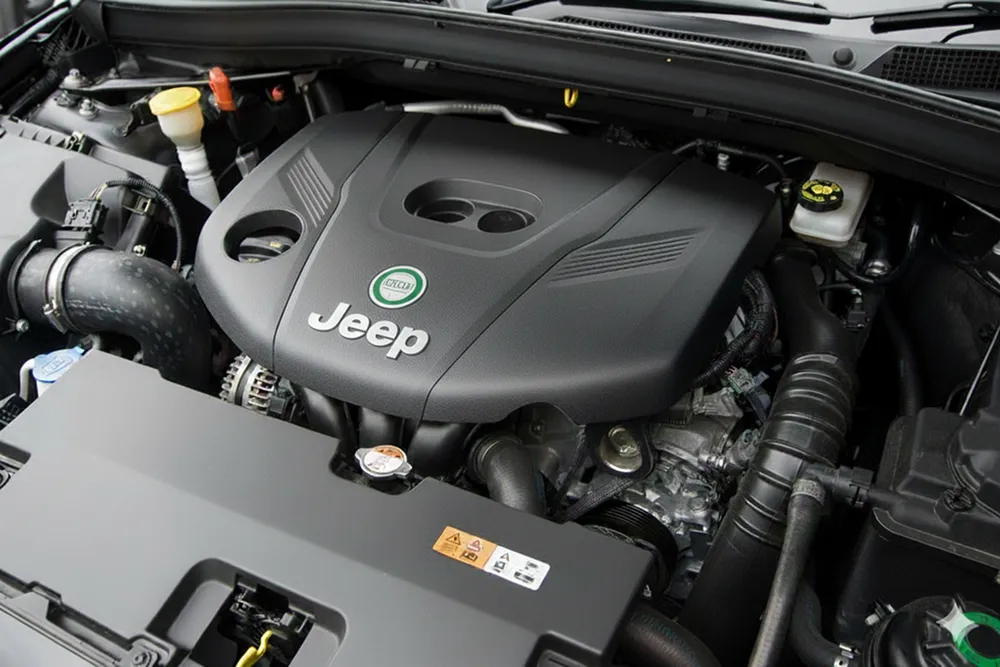
All production years (2018–2023) meet Euro 6d standards as per original type approval (VCA UK Type Approval #VCA/EMS/8901).
The Jeep eTorque is a 48V mild-hybrid system engineered for Wrangler, Gladiator, and Grand Cherokee (2018-2023). It combines a belt-driven starter-generator with turbocharged or naturally aspirated petrol engines to deliver torque-fill and seamless stop-start functionality. Designed to meet Euro 6d standards, it balances performance enhancement with fuel economy.
| Parameter | Value | Source |
|---|---|---|
System type | 48V Mild Hybrid (MHEV) | |
Primary engine | 2.0L Turbo I4 or 3.6L V6 Petrol | |
Electric motor | Belt-driven starter-generator (BSG) | |
Peak electric torque | 130 Nm | |
Battery type | Lithium-ion (48V, 0.43 kWh) | |
System function | Torque-fill, Stop-start, Energy recuperation | |
Emissions standard | Euro 6d | |
Cooling system | Liquid-cooled battery module | |
Integration | Integrated with 8-speed automatic transmission | |
Oil type (engine) | FCA MS-12991 (5W-30) for 2.0T; MS-6395 (5W-20) for 3.6L | |
System weight | 18 kg (additional to base engine) |
The Jeep eTorque system was used across Jeep's Wrangler (JL), Gladiator (JT), and Grand Cherokee (WL) platforms with longitudinal mounting. This system received platform-specific adaptations-unique mounting brackets for the Gladiator and revised cooling routing for the Grand Cherokee-and from 2021 the facelifted models adopted updated 48V control modules and software, creating minor electronic interchange limits. All adaptations are documented in OEM technical bulletins.
The eTorque system's primary reliability consideration is 48V system communication stability under thermal stress, with elevated incidence in extreme climate environments. Stellantis internal quality reports from 2021 noted a measurable rate of 48V module faults in pre-MY2021 builds, while owner feedback frequently cites GPF regeneration issues in predominantly short-trip urban driving. Consistent use of correct fuel grade and oil specification makes preventative maintenance critical.
Analysis derived from Stellantis technical bulletins (2020-2023) and owner-reported failure data (2021-2024). Repair procedures should follow manufacturer guidelines.
The most common questions about engine codes, what they mean, how to find them and how this database works
The eTorque system is generally robust, enhancing drivability without major reliability concerns. Early models (2018-2020) had a noted 48V communication issue, addressed in MY2021 with revised hardware and software. With proper maintenance and adherence to fuel/oil specifications for the base engine, the system can be very reliable long-term.
The most common issues are potential 48V system communication faults (pre-2021), GPF clogging from short trips, BSG noise or failure, and wiring harness chafing. These are well-documented in Stellantis service bulletins and owner reports. The system itself adds minimal complexity compared to full hybrids.
The eTorque mild-hybrid system was available on the Jeep Wrangler (JL) from 2018-2023 (with 2.0T or 3.6L V6), Jeep Gladiator (JT) from 2019-2023 (with 3.6L V6), and Jeep Grand Cherokee (WL) from 2021-2023 (with 3.6L V6). It was offered as an option to improve fuel economy and drivability.
The eTorque system itself cannot be tuned, as its output is fixed. However, the base petrol engines (2.0T or 3.6L V6) can be ECU remapped for increased power. Stage 1 tunes can safely increase the 2.0T to around 300-320 PS. The eTorque's torque-fill function complements tuned engines well, but supporting modifications and high-quality fuel are essential.
The eTorque system typically improves fuel economy by 1-2 L/100km compared to non-eTorque equivalents. In a Wrangler 2.0T eTorque, expect around 10.5 L/100km (27 mpg UK) combined versus 11.5-12.0 L/100km for the non-hybrid. Real-world gains vary significantly with driving style and terrain.
Beyond the base engine's maintenance, the eTorque system requires periodic inspection of the 48V battery module connections and ensuring the accessory drive belt is in good condition. The 48V lithium-ion battery is sealed and maintenance-free, with an expected lifespan matching the vehicle. No special fluids or regular servicing are required for the eTorque components themselves.
If the 48V battery fails, the eTorque system will be disabled, and the vehicle will default to operating as a conventional petrol engine. You'll lose the torque-fill and stop-start functions, and a warning light will illuminate. The vehicle remains drivable, but the 48V battery module should be replaced with an OEM unit to restore full functionality.
Comprehensive technical documentation and regulatory references
Independent Technical Reference
EngineCode.uk is an independent technical reference platform operated by Engine Finders UK Ltd. We are not affiliated with JEEP or any other manufacturer. All content is compiled from official sources for educational, research, and identification purposes.
Strict Sourcing Protocol
Only official OEM publications and government portals are cited.
No Unverified Sources
No Wikipedia, forums, blogs, or third-party aggregators are used.
Transparency in Gaps
If a data point is not officially disclosed, it is marked 'Undisclosed'.
Regulatory Stability
EU regulations are referenced using CELEX identifiers for long-term stability.
JEEP Official Site
Owner literature, service manuals, technical releases, and plant documentation.
EUR-Lex
EU emissions and type-approval regulations (e.g., CELEX:32007R0715, CELEX:32017R1151).
GOV.UK: Vehicle Approval & V5C
UK vehicle approval processes, import rules, and MoT guidance.
DVLA: Engine Changes & MoT
Official guidance on engine swaps and inspection implications.
Vehicle Certification Agency (VCA)
UK type-approval authority for automotive products.
Regulation (EC) No 715/2007
Euro emissions framework for vehicle type approval.
Commission Regulation (EU) 2017/1151
WLTP and RDE testing procedures for emissions certification.
GOV.UK: Vehicle Approval
UK compliance and certification requirements for imported and modified vehicles.
VCA Certification Portal
Type-approval guidance and documentation.
Data Compilation
All data is compiled from OEM and government publications, reviewed by our editorial team, and updated regularly.
Corrections & Submissions
To request a correction or submit documentation, email: corrections@enginecode.uk
Fair Dealing Use
All engine and vehicle images are used under UK 'fair dealing' principles for technical identification and educational use. Rights remain with their respective owners.
Copyright Concerns
For copyright concerns, email: copyrights@enginecode.uk
GDPR Compliance
EngineCode.uk complies with UK GDPR. We do not collect personal data unless explicitly provided.
Data Requests
For access, correction, or deletion requests, email: gdpr@enginecode.uk
Trademark Notice
All trademarks, logos, and engine codes are the property of their respective owners. Use on this site is strictly for reference and identification.
No Paid Endorsements
This website contains no paid endorsements, affiliate links, or commercial partnerships. We do not sell parts or services.
Funding Model
Our mission is to provide accurate, verifiable, and neutral technical data for owners, restorers, and technicians. This site is self-funded.
All specifications and compatibility data verified against officialJEEP documentation and EU/UK regulatory texts. Where official data is unavailable, entries are marked “Undisclosed”.
All external links open in new tabs. Please verify current availability of resources.