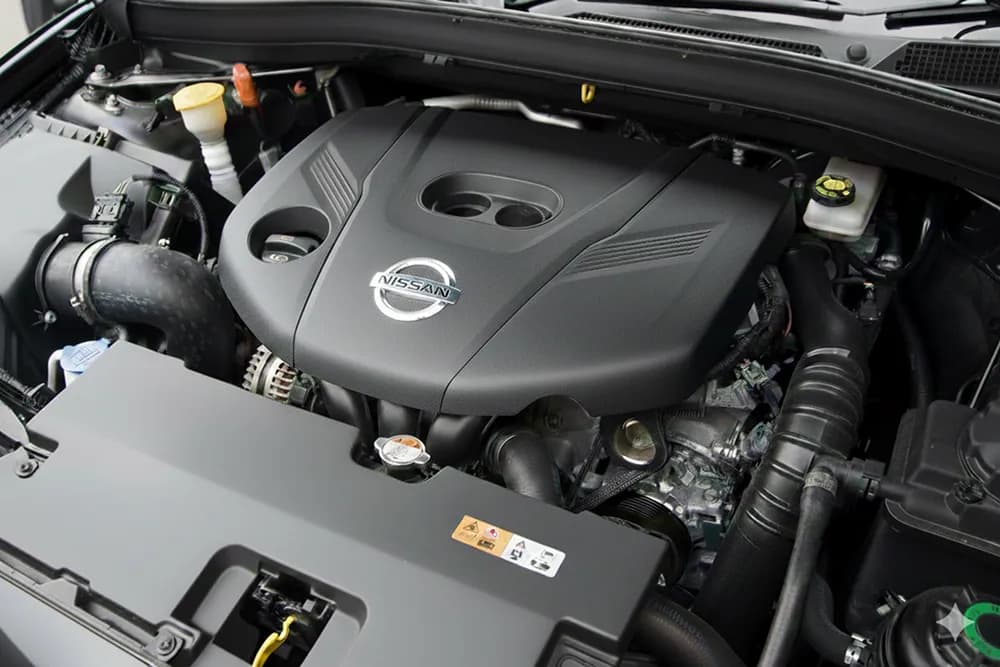
The Nissan VK56DE is a 5,552 cc, 90 — degree V8 naturally aspirated petrol engine produced from 2003 to 2020. It features a dual overhead camshaft (DOHC) design with 32 valves and Nissan's Variable Valve Event and Lift (VVEL) system on later variants. This engine was engineered for robust torque delivery and smooth, linear power in large SUVs and trucks, prioritizing durability over peak horsepower.
Fitted primarily to the Armada, Titan, Patrol, and Navara (in select mark…
Production years 2003–2020 meet applicable US EPA Tier 2 Bin 5 and equivalent global emissions standards for the period (EPA Certification).
The Nissan VK56DE is a 5,552 cc 90-degree V8 naturally aspirated petrol engine engineered for full-size trucks and SUVs (2003-2020). It combines DOHC 32-valve architecture with electronic fuel injection to deliver substantial low-end torque and towing capacity. Designed to meet contemporary US and global emissions standards, it emphasizes mechanical robustness for demanding applications.
| Parameter | Value | Source |
|---|---|---|
Displacement | 5,552 cc | |
Fuel type | Petrol | |
Configuration | V8, DOHC, 32-valve | |
Aspiration | Naturally Aspirated | |
Bore × stroke | 98.0 mm × 92.0 mm | |
Power output | 298–317 kW (400–425 PS) | |
Torque | 545–560 Nm @ 3,600 rpm | |
Fuel system | Sequential Multi-Point Fuel Injection (MPI) | |
Emissions standard | US EPA Tier 2 Bin 5 / Equivalent Global | |
Compression ratio | 9.8:1 | |
Cooling system | Water‑cooled | |
Turbocharger | None | |
Timing system | Chain-driven | |
Oil type | 5W-30 API SN or equivalent | |
Dry weight | 245 kg |
The Nissan VK56DE was used across Nissan's full-size truck and SUV platforms with longitudinal mounting. This engine received platform-specific adaptations-unique engine mounts and accessory drives for the Titan/Patrol versus the Armada-and no major facelift revisions that altered core compatibility. All adaptations are documented in OEM technical bulletins.
Engine Finders UK Ltd, which operates EngineCode.uk, can pass your enquiry to engine suppliers in the UK. The service is for vehicles in the United Kingdom, with UK delivery or fitting. This is a commercially connected service, and sending an enquiry does not confirm diagnosis or compatibility.
Diagnostic reminder: If a technician has recommended replacing the engine, you can send an enquiry to engine suppliers in the UK. Confirm the diagnosis first: an engine-code record does not diagnose a fault.
The VK56DE's primary reliability consideration is managing potential oil consumption and ensuring cooling system integrity under heavy load. Nissan technical bulletins document elevated oil usage in early builds, addressed by TSB NTB09-114, while owner data suggests radiator and water pump failures are common after 150,000 km. Sustained towing without adequate cooling or infrequent oil changes accelerates wear.
Analysis derived from Nissan technical bulletins (2003-2020) and aggregated owner maintenance logs. Repair procedures should follow manufacturer guidelines.
The most common questions about engine codes, what they mean, how to find them and how this database works
Yes, the VK56DE is generally considered a robust and reliable engine, especially post-2009 with the updated piston rings. Its V8 design is built for durability in trucks and SUVs. Key to its longevity is adhering to maintenance, particularly oil changes and cooling system checks. Neglect, especially infrequent oil changes or ignoring cooling issues, is the primary cause of failure.
The most frequent issues are excessive oil consumption (primarily in pre-2009 models), cooling system failures (radiator, water pump), ignition coil failures, and IMRC valve actuator problems. These are well-documented in Nissan service literature and owner reports, with specific fixes available via TSBs.
The VK56DE powered the Nissan Titan (2003-2015), Nissan Armada (2003-2015), Nissan Patrol (Y61/Y62, 2010-2020 in various global markets), and select V8 versions of the Nissan Navara (D40, 2005-2014 in markets like the Middle East).
Yes, the VK56DE responds well to basic bolt-on modifications. Common upgrades include a cold air intake, performance exhaust, and ECU tune, which can yield 20-40 additional horsepower. Its strong internals can handle moderate power increases, but significant forced induction requires careful planning and supporting modifications to the fuel and cooling systems.
Fuel economy is typical for a large, naturally aspirated V8. Expect around 15-18 L/100km (15-18 mpg US) in combined driving for a Titan or Armada. Fuel consumption will be significantly higher under heavy load, towing, or aggressive driving. It prioritizes power and torque over efficiency.
Yes. The VK56DE is an interference engine. If the timing chain fails or jumps, the pistons will collide with the open valves, causing catastrophic internal engine damage. While the chains are generally robust, regular inspections for wear or noise are advised.
Nissan recommends 5W-30 viscosity oil meeting API SN (or newer) or ILSAC GF-5 specifications. For normal driving, conventional or synthetic blend is acceptable. For severe service (towing, off-roading, extreme temperatures), a high-quality full synthetic 5W-30 is strongly recommended. Change intervals should be 7,500-10,000 km.
Comprehensive technical documentation and regulatory references
EngineCode.uk is operated by Engine Finders UK Ltd. It provides engine-reference information and an optional commercial enquiry service. It is not an official manufacturer website. Check the record's sources and confirm vehicle-specific details before relying on it for parts, repairs or replacement.
Our editorial standard prioritises relevant manufacturer documentation and official regulatory sources. The sources and verification status for a record should be checked alongside the data.
A statement is not verified merely because a source is listed. Where supporting evidence is missing or conflicting, the record should identify that limitation. Please report unsupported or inconsistent information.
Transparency in gaps
A missing or unverified value does not mean the manufacturer has withheld it. We distinguish information not yet verified, information not available to us, and information explicitly not disclosed by the source.
Regulatory Stability
EU regulations are referenced using CELEX identifiers for long-term stability.
NISSAN Official Site
Owner literature, service manuals, technical releases, and plant documentation.
EUR-Lex
EU emissions and type-approval regulations (e.g., CELEX:32007R0715, CELEX:32017R1151).
GOV.UK: Vehicle Approval & V5C
UK vehicle approval processes, import rules, and MoT guidance.
DVLA: Engine Changes & MoT
Official guidance on engine swaps and inspection implications.
Vehicle Certification Agency (VCA)
UK type-approval authority for automotive products.
Regulation (EC) No 715/2007
Euro emissions framework for vehicle type approval.
Commission Regulation (EU) 2017/1151
WLTP and RDE testing procedures for emissions certification.
GOV.UK: Vehicle Approval
UK compliance and certification requirements for imported and modified vehicles.
VCA Certification Portal
Type-approval guidance and documentation.
Records are subject to review and correction. Source links, dates and verification notes should be read with the technical information. Our Editorial and Sourcing Policy explains our standards and review process.
Found an error or missing source? Report a problem with this page. Include the field or statement concerned and a supporting source if available. You can also email corrections@enginecode.uk.
Copyright and permissions
Images and other material may be protected by copyright. Attribution does not by itself grant permission to reuse material. If you believe material on this site infringes your rights, contact copyrights@enginecode.uk with the page URL and details of your claim. We will review the material and take appropriate action.
Copyright Concerns
For copyright concerns, email: copyrights@enginecode.uk
Our Privacy Policy explains how Engine Finders UK Ltd uses information from visits, vehicle lookups, enquiries and messages. Our Cookie Policy explains cookies and similar technologies and how to change your choices.
For access, correction, or deletion requests, email: gdpr@enginecode.uk
Trademark Notice
All trademarks, logos, and engine codes are the property of their respective owners. Use on this site is strictly for reference and identification.
Ownership and commercial services
EngineCode.uk is owned and operated by Engine Finders UK Ltd. Alongside our reference content, we offer an optional replacement-engine enquiry service through Engine Finders and may identify relevant services provided by businesses connected with us. These commercial connections are disclosed. Using an enquiry service is not required to read our reference content.
Engine Finders UK Ltd operates this website. Our optional enquiry service has a commercial purpose. Our Ownership and Commercial Disclosure explains the relationship between the reference website and that service. Participating suppliers pay a fee or subscription to participate on the network and receive quote requests.
Use this record as a starting point for identification. Specifications and vehicle applications may contain errors or omissions. Confirm the exact engine variant and compatibility using vehicle-specific documentation and a qualified supplier or technician.
All external links open in new tabs. Please verify current availability of resources.