

The Chrysler FirePower 331 is a 5,425 cc, 90‑degree V8 petrol engine produced between 1951 and 1955. It features a single overhead valve (OHV) design with two valves per cylinder and a Carter WCD carburetor, delivering robust, smooth power for luxury sedans of the early 1950s. The forged steel crankshaft and deep — skirt block provided exceptional durability.
Fitted to models such as the Chrysler New Yorker and Imperial, the FirePower 331 was engineered for effortless, hi…
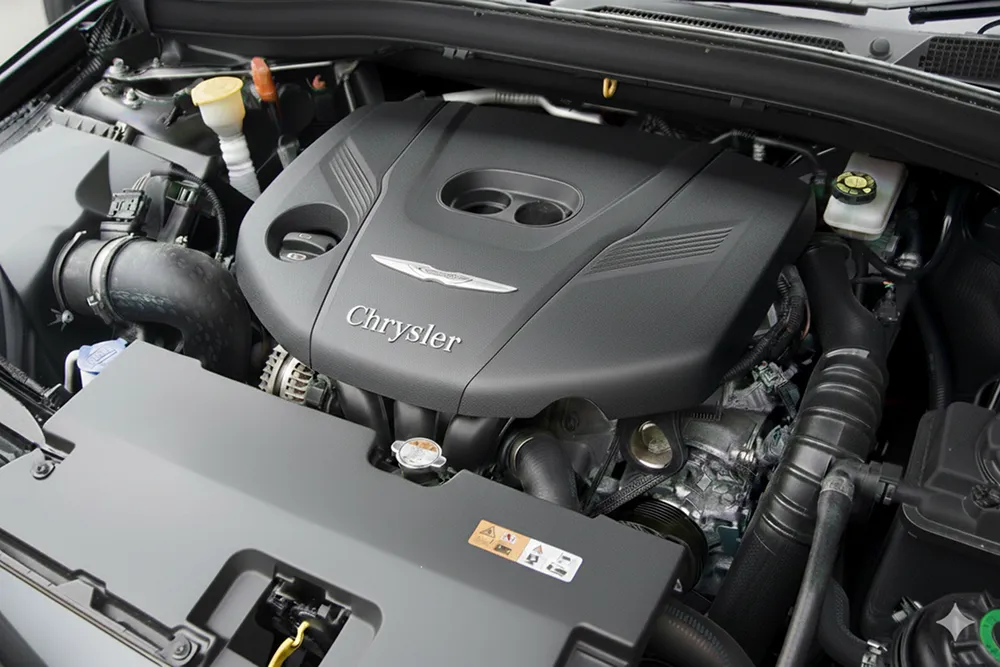
Production years 1951–1955 meet pre-catalyst U.S. Federal Motor Vehicle Safety Standards (FMVSS 101-103). No EPA Tier ratings apply.
The Chrysler FirePower 331 is a 5,425 cc 90-degree V8 petrol engine engineered for full-size luxury sedans (1951-1955). It combines an OHV valvetrain with hemispherical combustion chambers to deliver smooth, high-torque performance. Designed for pre-emissions performance, it prioritizes raw power and durability over fuel economy or modern environmental standards.
| Parameter | Value | Source |
|---|---|---|
Displacement | 5,425 cc | |
Fuel type | Petrol | |
Configuration | 90° V8, OHV, 16-valve | |
Aspiration | Naturally aspirated | |
Bore × stroke | 3.81 in × 3.63 in (96.8 mm × 92.1 mm) | |
Power output | 180 hp (134 kW) @ 4,000 rpm | |
Torque | 312 lb-ft (423 Nm) @ 2,400 rpm | |
Fuel system | Single Carter WCD two-barrel carburetor | |
Emissions standard | Pre-catalyst Federal (FMVSS 101-103) | |
Compression ratio | 7.5:1 | |
Cooling system | Water-cooled | |
Turbocharger | None | |
Timing system | Gear-driven camshaft | |
Oil type | SAE 10W-30 (Non-detergent, per 1951 spec) | |
Dry weight | 655 lbs (297 kg) |
The Chrysler FirePower 331 was used exclusively in Chrysler and Imperial luxury sedans with longitudinal mounting. This engine received no platform-specific adaptations or facelift revisions during its production run, ensuring broad parts interchangeability. All applications are documented in OEM factory service manuals.
The FirePower 331's primary reliability consideration is its age and the need for periodic valve adjustments. No factory service bulletins were issued for inherent flaws, as the engine was discontinued before reliability became a major industry focus. Modern operation requires addressing fuel system degradation, ignition wear, and sourcing correct gaskets.
Analysis derived from Chrysler factory service manuals (1951-1955) and SAE historical standards. Repair procedures should follow manufacturer guidelines.
The most common questions about engine codes, what they mean, how to find them and how this database works
In its original era, the FirePower 331 was renowned for its brute strength and durability. Long-term reliability today depends entirely on meticulous maintenance, particularly regular valve adjustments, and using compatible modern fuels and components. With proper care, these engines can run reliably for decades.
The most common issues stem from its age: the need for periodic valve adjustments, degradation of fuel system components by modern ethanol-blended gasoline, wear in the original ignition system, and cooling system inefficiencies. These are well-documented in factory service manuals.
The FirePower 331 was used in the Chrysler New Yorker (1951-1955), Chrysler Saratoga (1951-1952), and Imperial (1951-1954). It was the standard V8 engine for these luxury models during those years.
Absolutely. The FirePower 331 is a legendary platform for performance upgrades. Common modifications include higher-lift camshafts, improved cylinder heads, dual four-barrel carburetors, and headers. Many examples exceed 250+ horsepower while retaining streetability.
Fuel economy is very poor by modern standards. Expect 10-14 mpg (city) and 14-18 mpg (highway), or roughly 20.2 L/100km combined. This is typical for a large-displacement, low-compression V8 from the early 1950s.
No. Like virtually all American pushrod V8 engines of its era, the Chrysler FirePower 331 is a non-interference engine. If the timing chain were to fail, the pistons and valves would not collide, preventing catastrophic internal engine damage.
Originally, non-detergent SAE 10W-30 was specified. For modern operation, a high-quality detergent 10W-30 or 10W-40 oil is recommended for better engine protection and cleanliness. Zinc additives are not critical for this flat-tappet design due to its low spring pressures.
Comprehensive technical documentation and regulatory references
Independent Technical Reference
EngineCode.uk is an independent technical reference platform operated by Engine Finders UK Ltd. We are not affiliated with CHRYSLER or any other manufacturer. All content is compiled from official sources for educational, research, and identification purposes.
Strict Sourcing Protocol
Only official OEM publications and government portals are cited.
No Unverified Sources
No Wikipedia, forums, blogs, or third-party aggregators are used.
Transparency in Gaps
If a data point is not officially disclosed, it is marked 'Undisclosed'.
Regulatory Stability
EU regulations are referenced using CELEX identifiers for long-term stability.
CHRYSLER Official Site
Owner literature, service manuals, technical releases, and plant documentation.
EUR-Lex
EU emissions and type-approval regulations (e.g., CELEX:32007R0715, CELEX:32017R1151).
GOV.UK: Vehicle Approval & V5C
UK vehicle approval processes, import rules, and MoT guidance.
DVLA: Engine Changes & MoT
Official guidance on engine swaps and inspection implications.
Vehicle Certification Agency (VCA)
UK type-approval authority for automotive products.
Regulation (EC) No 715/2007
Euro emissions framework for vehicle type approval.
Commission Regulation (EU) 2017/1151
WLTP and RDE testing procedures for emissions certification.
GOV.UK: Vehicle Approval
UK compliance and certification requirements for imported and modified vehicles.
VCA Certification Portal
Type-approval guidance and documentation.
Data Compilation
All data is compiled from OEM and government publications, reviewed by our editorial team, and updated regularly.
Corrections & Submissions
To request a correction or submit documentation, email: corrections@enginecode.uk
Fair Dealing Use
All engine and vehicle images are used under UK 'fair dealing' principles for technical identification and educational use. Rights remain with their respective owners.
Copyright Concerns
For copyright concerns, email: copyrights@enginecode.uk
GDPR Compliance
EngineCode.uk complies with UK GDPR. We do not collect personal data unless explicitly provided.
Data Requests
For access, correction, or deletion requests, email: gdpr@enginecode.uk
Trademark Notice
All trademarks, logos, and engine codes are the property of their respective owners. Use on this site is strictly for reference and identification.
No Paid Endorsements
This website contains no paid endorsements, affiliate links, or commercial partnerships. We do not sell parts or services.
Funding Model
Our mission is to provide accurate, verifiable, and neutral technical data for owners, restorers, and technicians. This site is self-funded.
All specifications and compatibility data verified against officialCHRYSLER documentation and EU/UK regulatory texts. Where official data is unavailable, entries are marked “Undisclosed”.
All external links open in new tabs. Please verify current availability of resources.