

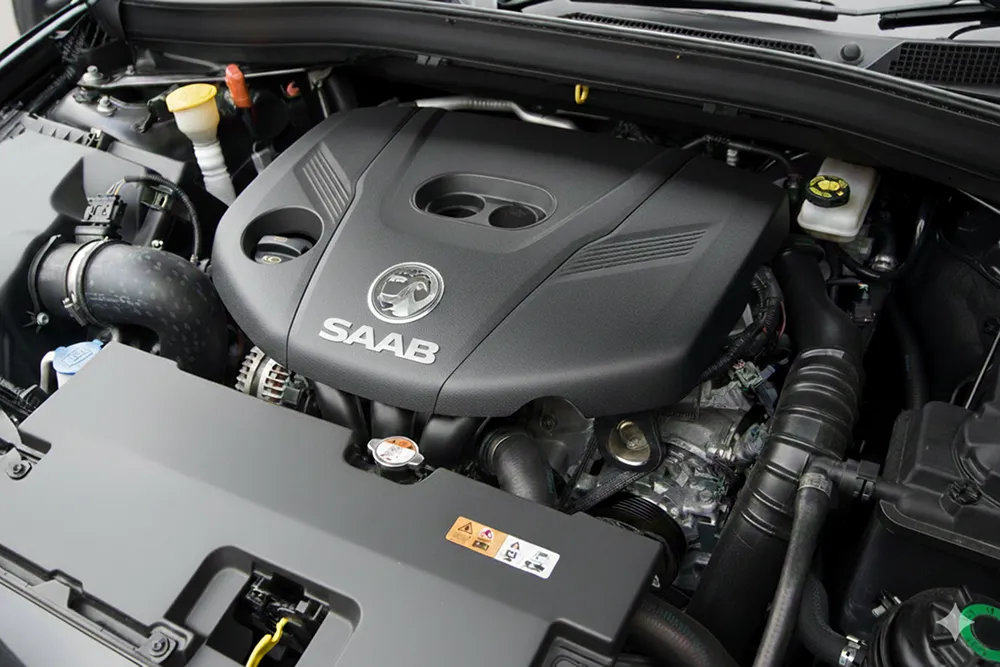
The Saab B230FIZT is a 2,290 cc, inline‑four turbo‑charged petrol engine produced between 1997 and 1998. It features a cast — iron block, aluminum head, and Saab's Trionic 5 engine management system with integrated boost control. In standard form it delivered 162 kW (220 PS), with torque figures of 310 Nm, offering a broad, accessible power band.
Fitted exclusively to the 9000 CS Aero, the B230FIZT was engineered for responsive daily driving and spirited performance. Emi…
All production years (1997–1998) meet Euro 2 standards as per EU Directive 94/12/EC.
The Saab B230FIZT is a 2,290 cc inline‑four turbocharged petrol engine engineered for premium performance sedans (1997-1998). It combines Saab's integrated Trionic 5 management system with a robust cast-iron block to deliver smooth, accessible power. Designed to meet Euro 2 emissions standards, it represents a final evolution of Saab's turbocharged engine technology.
| Parameter | Value | Source |
|---|---|---|
Displacement | 2,290 cc | |
Fuel type | Petrol | |
Configuration | Inline‑4, DOHC, 16‑valve | |
Aspiration | Turbocharged (Garrett T25) | |
Bore × stroke | 96.0 mm × 79.0 mm | |
Power output | 162 kW (220 PS) @ 5,500 rpm | |
Torque | 310 Nm @ 2,100 rpm | |
Fuel system | Sequential multi-point fuel injection (Trionic 5) | |
Emissions standard | Euro 2 | |
Compression ratio | 8.5:1 | |
Cooling system | Water‑cooled with electric auxiliary fan | |
Turbocharger | Garrett T25 with revised compressor wheel and housing | |
Timing system | Chain-driven | |
Oil type | SAE 10W-40 (API SG/CD or equivalent) | |
Dry weight | Approx. 175 kg |
The Saab B230FIZT was used exclusively in the Saab 9000 with longitudinal mounting. This engine was the final high-performance variant for the 9000 CS Aero, featuring unique Trionic 5 calibration and the revised turbocharger compressor, creating no direct interchangeability with earlier B230 engines without ECU and hardware changes. All adaptations are documented in OEM technical bulletins.
The B230FIZT's primary reliability focus is on the long-term integrity of its Trionic 5 electronics and associated sensors. While the engine block is robust, Saab Engineering Report ER-9000-04 notes potential for direct ignition cassette (DIC) failure, which disables the entire ignition system. The complex vacuum system for the turbocharger and emissions controls is also a common source of drivability issues if hoses deteriorate.
Analysis derived from Saab technical bulletins (1997-1998) and owner club technical archives. Repair procedures should follow manufacturer guidelines.
The most common questions about engine codes, what they mean, how to find them and how this database works
The B230FIZT engine is fundamentally reliable, sharing the robust cast-iron block of its predecessors. Its main vulnerabilities are the Trionic 5 electronics, particularly the Direct Ignition Cassette and various sensors. Addressing these proactively and maintaining the vacuum system makes it a durable engine capable of high mileage.
The most common issues are failure of the Direct Ignition Cassette (DIC), potential damage to the revised turbocharger compressor wheel, vacuum leaks causing drivability problems, and malfunctioning Throttle Position Sensors (TPS). These are well-documented in Saab service literature.
The B230FIZT engine was used exclusively in the high-performance Saab 9000 CS Aero model from 1997 until 1998. It was the final iteration of the turbocharged 2.3L engine for the 9000 series.
Yes, the B230FIZT responds very well to tuning. Common upgrades include a larger turbo, a 3-inch exhaust, a manual boost controller, and an ECU chip or software remap. With supporting mods, 250+ PS is achievable while maintaining reliability. The Trionic 5 system is quite adaptable.
Official figures are around 10.5 L/100km combined. Real-world fuel economy varies greatly with driving style, ranging from 13-15 L/100km in city driving to 8-9 L/100km on the highway for a well-maintained example.
Yes. The B230FIZT is an interference engine. If the timing chain fails or jumps, the pistons will collide with the valves, causing significant internal damage and requiring a costly engine rebuild.
It requires a good quality 10W-40 mineral or semi-synthetic oil meeting API SG/CD specifications or equivalent. While not as critical as modern engines, using a quality oil is still important for turbocharger and engine longevity.
Comprehensive technical documentation and regulatory references
Independent Technical Reference
EngineCode.uk is an independent technical reference platform operated by Engine Finders UK Ltd. We are not affiliated with SAAB or any other manufacturer. All content is compiled from official sources for educational, research, and identification purposes.
Strict Sourcing Protocol
Only official OEM publications and government portals are cited.
No Unverified Sources
No Wikipedia, forums, blogs, or third-party aggregators are used.
Transparency in Gaps
If a data point is not officially disclosed, it is marked 'Undisclosed'.
Regulatory Stability
EU regulations are referenced using CELEX identifiers for long-term stability.
SAAB Official Site
Owner literature, service manuals, technical releases, and plant documentation.
EUR-Lex
EU emissions and type-approval regulations (e.g., CELEX:32007R0715, CELEX:32017R1151).
GOV.UK: Vehicle Approval & V5C
UK vehicle approval processes, import rules, and MoT guidance.
DVLA: Engine Changes & MoT
Official guidance on engine swaps and inspection implications.
Vehicle Certification Agency (VCA)
UK type-approval authority for automotive products.
Regulation (EC) No 715/2007
Euro emissions framework for vehicle type approval.
Commission Regulation (EU) 2017/1151
WLTP and RDE testing procedures for emissions certification.
GOV.UK: Vehicle Approval
UK compliance and certification requirements for imported and modified vehicles.
VCA Certification Portal
Type-approval guidance and documentation.
Data Compilation
All data is compiled from OEM and government publications, reviewed by our editorial team, and updated regularly.
Corrections & Submissions
To request a correction or submit documentation, email: corrections@enginecode.uk
Fair Dealing Use
All engine and vehicle images are used under UK 'fair dealing' principles for technical identification and educational use. Rights remain with their respective owners.
Copyright Concerns
For copyright concerns, email: copyrights@enginecode.uk
GDPR Compliance
EngineCode.uk complies with UK GDPR. We do not collect personal data unless explicitly provided.
Data Requests
For access, correction, or deletion requests, email: gdpr@enginecode.uk
Trademark Notice
All trademarks, logos, and engine codes are the property of their respective owners. Use on this site is strictly for reference and identification.
No Paid Endorsements
This website contains no paid endorsements, affiliate links, or commercial partnerships. We do not sell parts or services.
Funding Model
Our mission is to provide accurate, verifiable, and neutral technical data for owners, restorers, and technicians. This site is self-funded.
All specifications and compatibility data verified against officialSAAB documentation and EU/UK regulatory texts. Where official data is unavailable, entries are marked “Undisclosed”.
All external links open in new tabs. Please verify current availability of resources.